Teen Patti
Play Teen Patti free against three computer players, then learn how to play step by step: boot, blind and seen betting, show, side show and the hand rankings with exact odds.


Play Teen Patti free against three computer players, then learn how to play step by step: boot, blind and seen betting, show, side show and the hand rankings with exact odds.
Teen Patti means “three cards”. Four to seven players each receive three cards from a standard 52-card pack, aces high, and bet in turn until everyone but one player has folded or two players pay for a showdown. It is the same game the British call three-card brag, and it is the card game of Diwali night in most of India. Below you can play Teen Patti free against three computer players, then read how a hand is played step by step, the hand rankings with the exact odds behind them, the betting rules and the named variations — plus the part almost no rules page mentions, which is that the ranking order contradicts the game’s own probabilities.

You sit at the bottom against three computer players, Left, Across and Right, with play chips only. Everyone puts in a boot of 10 and gets three cards face down. On your turn you can bet blind without looking, press See cards and bet as a seen player (chaal), or Pack. When only two players are left, a Show button appears; when everyone left is seen, you can ask the player before you for a Side show. The table keeps track of who is blind, seen or packed, how much each player has put in, and the chips won or lost over the session.
In the free game you bet the minimum or double it (blind: 1 or 2 times the stake; seen: 2 or 4 times), A-2-3 is the highest sequence, a side show needs at least three players still in, and each hand has a pot limit of 1,000 chips: when the pot reaches it, every remaining hand is shown and the best one wins. Ties at the pot limit split the pot. The deal moves one seat to the left after every hand.
Teen Patti uses one 52-card pack with no jokers, aces high, and is best with about 4 to 7 players. Agree the size of the boot (the minimum stake) first. Every player puts the boot into the pot, then the dealer deals the cards one at a time until everyone has three.
You can look at your three cards and play seen (a seen player is called chaal), or leave them face down and play blind. Blind players bet half as much as seen players. A blind player can look at their cards when their turn comes, and from then on bets as a seen player.
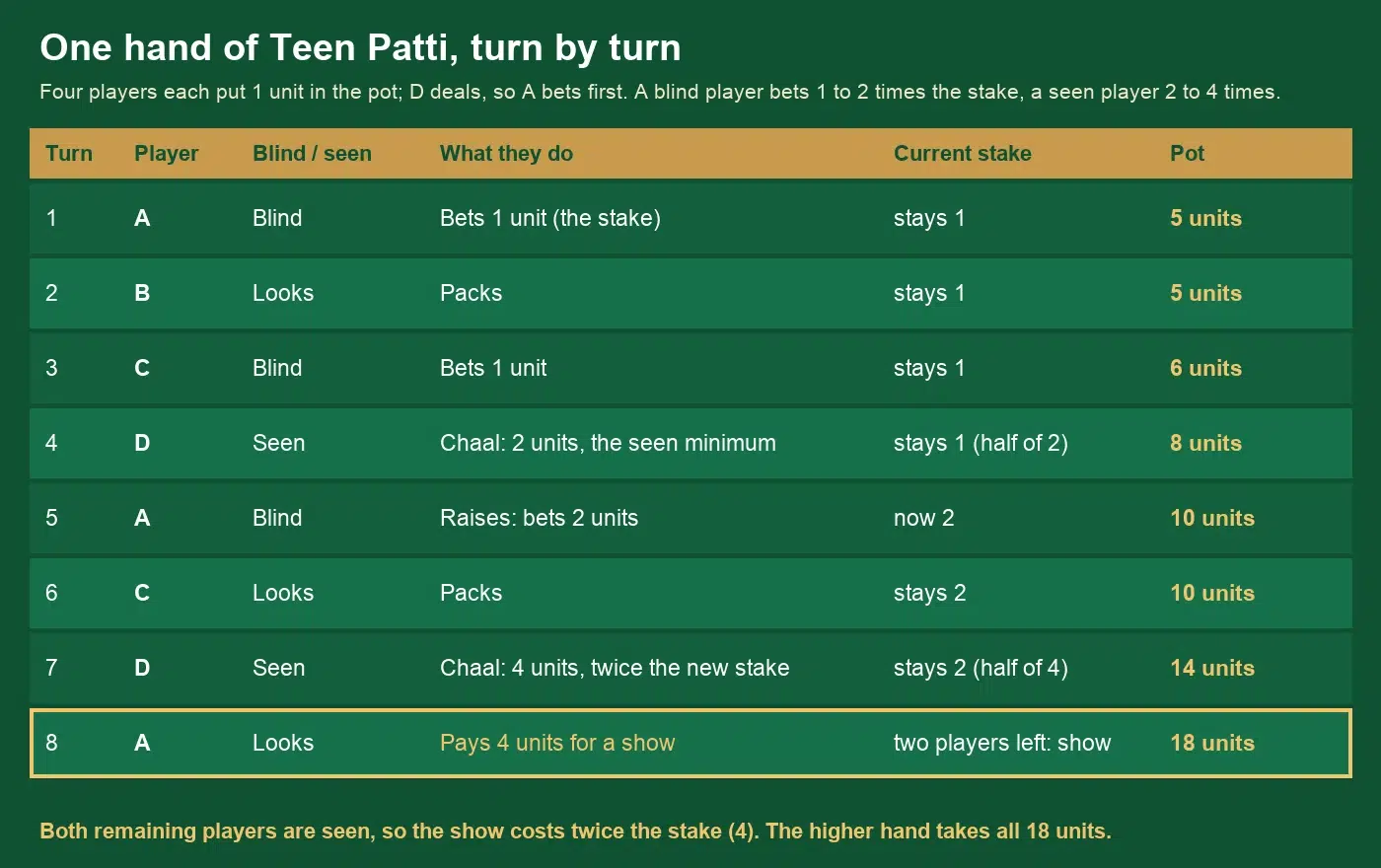
The player to the dealer’s left bets first, and the turn goes clockwise round the table for as many rounds as needed. At the start the current stake is one boot. On your turn you either put more money into the pot to stay in, or pack:
| Blind player | Seen player (chaal) | |
|---|---|---|
| You must bet | From the current stake up to twice the stake | From twice the stake up to four times the stake |
| The new current stake | The amount you bet | Half the amount you bet |
So a seen player who bets the minimum leaves the stake where it was, while a blind player who bets twice the stake doubles it for everyone. Unlike poker, nobody has to match anyone else’s total: each turn is simply a bet at the current rate.
If you pack (fold), you are out of the hand and lose everything you have put in the pot. If everyone except one player packs, that player wins the whole pot without showing their cards.
A show is only possible when just two players are left. One of them pays for it at their turn, both hands are turned face up, and the higher hand wins the pot:
| You are | The other player is | Can you ask for a show? | Cost |
|---|---|---|---|
| Blind | Blind or seen | Yes (you look at your cards only after paying) | The current stake |
| Seen | Seen | Yes | Twice the current stake |
| Seen | Blind | No: you can only bet or pack | – |
If the two hands are exactly equal, the player who did not pay for the show wins. There is never a showdown between three or more players.
When every player still in the hand is seen, you can bet the minimum (twice the stake) and ask the player who bet just before you for a side show, also called a compromise. If they accept, the two of you compare cards privately and the lower hand packs; if the hands are equal, the player who asked packs. If they refuse, betting simply carries on with the next player.
Many groups add a limit on blind play, for example that you must look at your cards by your fourth turn, and some charge twice the minimum bet for a show. Agree any house rules before the first deal.
There are 22,100 different three-card hands in a 52-card pack. Every one of them was enumerated to produce the table below, and each figure was checked a second time against a closed-form count — the two methods agree exactly and the six categories sum to 22,100.
| Hand | What it is | Combinations | Chance | Roughly |
|---|---|---|---|---|
| Trail / trio | Three cards of the same rank | 52 | 0.2353% | 1 in 425 |
| Pure sequence | Three consecutive cards, all one suit | 48 | 0.2172% | 1 in 460 |
| Sequence | Three consecutive cards, mixed suits | 720 | 3.2579% | 1 in 31 |
| Colour | Three of one suit, not consecutive | 1,096 | 4.9593% | 1 in 20 |
| Pair | Two cards of the same rank | 3,744 | 16.9412% | 1 in 6 |
| High card | None of the above | 16,440 | 74.3891% | 3 hands in 4 |
All 22,100 three-card hands enumerated, then verified against the closed-form counts 13×C(4,3), 12×4, 12×(4³−4), 4×C(13,3)−48 and 13×C(4,2)×48.
The first thing to take from that table has nothing to do with rare hands. Three hands in every four are nothing at all — no pair, no suit, no run. Teen Patti is not a game of made hands. It is a game of betting with rubbish, which is why the blind-and-seen structure below matters more than the ranking does.

Look again at the first two rows. A trail has 52 combinations. A pure sequence has 48. The trail is the more common of the two — and it beats the pure sequence.
That is backwards. In every mainstream card game, a hand ranks above another because it is harder to get. Poker’s five-card ladder is built that way from top to bottom. Teen Patti’s ladder is built that way too — sequence over colour, colour over pair, pair over high card, all correctly ordered by frequency — and then it inverts at the one place where it is decided who takes the biggest pot of the night.
The arithmetic is not close and it is not disputable. A trail is one rank chosen from thirteen, with three suits chosen from four: 13 × 4 = 52. A pure sequence is one of twelve valid runs in one of four suits: 12 × 4 = 48. Pure sequences are 7.7% scarcer, and they lose.
It is worth stating plainly that the most-cited English reference on the game gets this backwards. Wikipedia’s Teen Patti article says trios are ranked above straight flushes “despite trios being rarer” — which is both the wrong way round on the facts and self-contradictory as a sentence, since a rarer hand ranking higher would be the ordinary rule rather than something to be conceded. The counts above are what a deck actually contains.
There is a small practical consequence. Because the top hand in Teen Patti is the commoner of the two, the unbeatable holding turns up about 8% more often than it would under a frequency-correct ranking — once in 425 hands instead of once in 460. Not a reason to change how you play. Just not the ladder you were told it was.
Twelve runs of three are legal: A-K-Q, A-2-3, K-Q-J, Q-J-10 and downwards to 4-3-2. The ace works at both ends. K-A-2 does not exist — the ace does not wrap around the corner.
Which of those twelve is the highest is where it gets awkward. Pagat, the standard rules reference, says A-2-3 is the highest straight run and A-K-Q comes second. Wikipedia says the opposite: A-K-Q first, A-2-3 second. Both are widely followed, and the disagreement is about the single hand most likely to be holding the largest pot in the game. Settle it out loud before the first deal, not during a showdown.
Note what this does not affect: the set of legal runs is the same twelve under either reading, so every count in the table above is unchanged. Only the order within the category moves.
One small consequence of the ace being allowed at the bottom: A-2-3 is what keeps the run count at twelve rather than eleven. Without it there would be 44 pure sequences against 52 trails, and the ranking inversion would be wider still — 18% instead of 7.7%. The A-2-3 rule narrows the anomaly; it does not create it.
Rarity is not the same question as safety. What a player wants to know is how often the hand in front of them gets beaten. The left-hand column below is exact: for every one of the 22,100 hands, all 18,424 hands an opponent could hold from the remaining 49 cards were counted. The right-hand column is a two-million-deal simulation of a four-handed table.
| Your hand | One opponent beats you | You win a four-handed showdown |
|---|---|---|
| Trail | 0.130% | 99.56% |
| Pure sequence | 0.343% | 99.04% |
| Sequence | 2.039% | 93.47% |
| Colour | 6.243% | 82.52% |
| Pair | 17.213% | 57.46% |
| High card | 62.713% | 10.28% |
Exact head-to-head across all hands; four-handed figures from 2,000,000 simulated deals at a fixed seed. Two checks that the model is sound: averaged over all hands one opponent beats you 49.945% of the time, just under half with the remainder ties, and the four-handed win rates average to 24.97% against a fair share of 25%.
The number worth memorising is the pair. A pair feels like a hand. Against three opponents it wins 57% of showdowns — better than a coin toss and nothing more. Players lose money in Teen Patti by treating a pair as a reason to keep raising rather than a reason to see one more bet.
And in the other direction: high card wins a four-handed showdown once in ten. Since that is 74% of everything you are dealt, most of the money in this game changes hands between two players who both have nothing.
Everyone antes a boot into the pot. Then each player chooses, before betting, whether to look. A player who has not looked is blind; one who has is seen, and a seen player’s bet is called a chaal.
| Blind player | Seen player | |
|---|---|---|
| Minimum to stay in | The current stake | Twice the current stake |
| Maximum | Twice the current stake | Four times the current stake |
| Cost of a show | The current stake | Twice the current stake |
| May request a side show | No | Yes, only if all remaining players are seen |
Betting structure as given by Pagat. House rules vary, particularly on the cost of a show and on how many turns a player may stay blind.
So a seen player pays double throughout. That is the price of information, and it is the reason staying blind is a real strategy rather than a stunt: with three hands in four being high card, knowing your cards is often worth less than paying half price to see the next one. Many tables cap it — blind for the first three turns, then you must look.
A side show (or compromise) lets a seen player ask the player who bet immediately before them to compare hands privately; the loser folds. It can be refused, and refusing is itself information. A show ends the hand when two players remain.
Almost every household plays at least one variant, and they are usually announced by the dealer before the boot. These are the named ones that recur.
| Variation | What changes | What it does to the odds |
|---|---|---|
| Muflis (lowball) | The whole ranking reverses — the worst hand wins | The winning category becomes high card, which is 74% of all hands, so nearly every hand is “top pair” of the ladder and the game is decided almost entirely on card values |
| AK47 | Aces, kings, fours and sevens are wild | Four ranks — 16 of the 52 cards — become jokers, so trails and pure sequences stop being rare events |
| Best of Four | Four cards are dealt; each player picks three | Every player sees four hands’ worth of material, which lifts everyone’s average holding and devalues a pair sharply |
| High–Low split | The pot is split between the best and the worst hand | Rewards the extremes and punishes a middling colour, which now wins neither half |
| Wild card / joker | A named card or a randomly turned card is wild | Same effect as AK47 in miniature, scaled by how many cards are named |
| Community cards | Shared cards on the table, Hold’em style | Hands stop being independent, so the head-to-head figures above no longer apply at all |
Variation list per the Wikipedia article on Teen Patti; the odds column is worked out from the combination counts above.
Muflis is the one worth thinking about, because reversing the ladder does not simply mirror the game. In ordinary Teen Patti the top category holds 52 hands out of 22,100. In Muflis the top category holds 16,440. A ranking system designed to separate players by rarity is turned into one where three quarters of the table are in the same bracket and everything is settled by which low cards you hold. It is a different game wearing the same name.

This changed completely in 2025, and a great deal of what is written online about Teen Patti and Indian law predates it.
For decades the question was whether a game was one of skill or of chance. The Supreme Court held in State of Andhra Pradesh v. K. Satyanarayana (decided 22 November 1967) that rummy is preponderantly a game of skill, reasoning that the presence of a shuffle does not by itself make a game one of chance. Three-card games were generally treated on the other side of that line. Whole business models were built on which side a game fell.
The Promotion and Regulation of Online Gaming Act, 2025 (Act No. 32 of 2025, dated 22 August 2025) removes the distinction. Read at the text published by the Ministry of Electronics and Information Technology, its section 2(1)(g) defines an “online money game” as an online game — “irrespective of whether such game is based on skill, chance, or both” — played by paying fees or depositing money in expectation of winning. Section 5 then provides that “no person shall offer, aid, abet, induce or otherwise indulge or engage in the offering of online money game and online money gaming service”.
| Provision | What it does | Maximum penalty |
|---|---|---|
| Section 5 | Bans offering an online money game or money-gaming service | 3 years, or a fine up to 1 crore rupees, or both |
| Section 6 | Bans advertising that directly or indirectly promotes or induces a person to play one | 2 years, or a fine up to 50 lakh rupees, or both |
| Section 7 | Bans banks and payment facilitators from processing the transactions | 3 years, or a fine up to 1 crore rupees, or both |
Sections and penalties read from the Act as published by MeitY. Section 1(2) states the Act extends to the whole of India and also applies to a service “offered within the territory of India or operated from outside the territory of India”.
Two details in that table matter more than the headline. The first is that section 1(2) reaches operators outside India, so being registered abroad is not the shelter it was. The second is that section 6 bans the advertising as well as the game. E-sports and social games with no stakes are expressly outside the Act.
So: Teen Patti played at home over Diwali for counters is a family card game, and always has been. Teen Patti played online for money in India is now prohibited outright, whichever side of the old skill-versus-chance line anyone thinks it falls on. Gambling law differs enormously between countries, what an operator will accept differs again, and it is your responsibility to know what applies where you are.
Four operators reviewed on this site, in the order used for readers across South Asia, with the welcome offer each currently advertises.
| Operator | Welcome offer | Our rating | |
|---|---|---|---|
| Betwinner | Up to €1,500 + 150 free spins across four deposits | 4.2 | Open Betwinner |
| 1xBet | 100% up to €1,500 + 150 free spins | 4.0 | Open 1xBet |
| MegaPari | 100% up to €500 + 50 free spins, then 100% up to €1,000 + 100 free spins | 4.5 | Open MegaPari |
| 22Bet | Up to 1,743 USD + 150 free spins | 4.1 | Open 22Bet |
Welcome offers as published in the reviews on this site, where the wagering requirements and full conditions are set out.
Three cards each, aces high, 22,100 possible hands, and three of every four are nothing. The ladder runs trail, pure sequence, sequence, colour, pair, high card — correctly ordered by frequency everywhere except the top, where the commoner hand wins. A pair takes a four-handed showdown 57% of the time, which is far less than it feels. A seen player pays double a blind one for the privilege of knowing. Agree whether A-2-3 or A-K-Q is the higher run before you deal, because the two standard references disagree. And in India, since August 2025, the online money version is banned outright.
Also worth a look: Dragon Tiger strips the card comparison down to a single card per side — rules, payouts and the odds of every bet in our guide.
Also worth a look: our Jhandi Munda guide covers the rules, the six symbols, the odds and TaDa Gaming’s casino version.
Also worth a look: the casino cousin of Teen Patti is Three Card Poker, played against the dealer with a single play-or-fold decision.
Also worth a look: the British version of this game is Three Card Brag, with prials, runs and blind betting.
Also worth a look: Tambola, the 90-ball number game played at Indian parties, with a free number caller and tickets.
Another favourite card game: Callbreak (Call Break), the trick-taking game with spades as trumps; play it free against computer players.
Another popular Indian card game: Twenty-Nine (29), the partnership trick-taking game with a hidden trump; play it free against computer players.
India’s other favourite card game: Indian Rummy (13-card rummy), with jokers, pure sequences and sets; play it free against the computer.
Another card game from India: Mendicot (Dehla Pakad), the team game of capturing tens, with a free online version.
Another card game from India: Donkey (Getaway), the race to get rid of your cards, free to play online.

After going through several successful experiences with several industry pioneers, Fadi Hayek has managed to excel in the world of content for online gaming by providing unique content for several projects that allowed him to obtain the necessary experience to launch his career. Last but not least, Fadi also holds several certificates, including but not limited to content marketing and iGaming.


