Mendicot and Dehla Pakad
Play the Indian game of capturing tens free in your browser, and learn every rule of Mendikot and Dehla Pakad.


Play the Indian game of capturing tens free in your browser, and learn every rule of Mendikot and Dehla Pakad.
Mendicot (also written Mendikot, Mendhi Coat or Mindi) is a four-player partnership card game from India, especially popular in Maharashtra and Gujarat. Its northern cousin, Dehla Pakad, is played the same way with one twist. In both games the goal is simple to say and hard to do: capture the tens. Take three or four of the four tens in your tricks and your side wins the hand; take all four and you have a mendikot (a kot in Dehla Pakad).
Play both games free below with a computer partner, then read the full rules: the deal, the ways of choosing trumps (hukum), how tricks are won, how a hand is decided, Dehla Pakad’s two-in-a-row rule, who deals next, the odds of holding tens, and tips for play.
You sit at the bottom with Across as your partner; Right and Left play against you, and play goes to the right. Pick the game at the top. Only the cards you are allowed to play are lit, and tens in your hand are shaded so you can keep track of them. The scoreboard counts the tens and tricks each side has taken in the current hand, and the hands and mendikots (kots) won so far.
In the Mendicot game trumps are chosen by cut hukum: there are no trumps until somebody cannot follow suit. In Dehla Pakad the player to the dealer’s right chooses trumps after seeing five cards. When that player is you, the game asks you to choose.
| Mendicot (Mendikot) | Dehla Pakad | |
|---|---|---|
| Players | 4, two teams, partners opposite | 4, two teams, partners opposite |
| Cards | Standard 52-card pack, A high | Standard 52-card pack, A high |
| Direction | Anticlockwise | Anticlockwise |
| Aim | Capture tens in your tricks | Capture tens (“Dehla Pakad” means “collect the tens”) |
| Trumps (hukum) | Random card, closed trump (band hukum) or cut hukum | Named from five cards, or set by the first player who cannot follow |
| Taking tricks | Every trick goes to the side that wins it | Only when the same player wins two tricks in a row |
| Winning a hand | 3 or 4 tens; at 2–2 the side with 7+ tricks | 4 tens, or 2–3 tens for non-dealers, 3 for the dealer’s side |
| Big win | Mendikot (all 4 tens); 52-card mendikot (all 13 tricks) | Kot (all 4 tens, or seven hands in a row) |
Four players play in two teams, partners sitting opposite each other, with a standard 52-card pack. Cards rank from high to low A, K, Q, J, 10, 9, 8, 7, 6, 5, 4, 3, 2 in every suit. Deal and play go anticlockwise. The dealer gives everyone 13 cards, first a batch of five each and then the rest in batches of four.
Only the four tens matter for the result. The name comes from them: mendi is said to come from the Gujarati word for zero, because the 10 is the only card with a zero on it, and kot is a word used in several South Asian card games for a win in which the other side scores nothing.
The trump suit is called the hukum. Agree before the session which of these methods you will use:
| Method | How trumps are chosen |
|---|---|
| Random card | After the shuffle, the player to the dealer’s right draws a card at random and shows it; its suit is trumps. The card goes back into the pack before the deal. |
| Band hukum (closed trump) | The player to the dealer’s right puts one card from their hand face down. Its suit is trumps, revealed once somebody cannot follow suit (or, in one version, when a player who cannot follow asks for it). |
| Cut hukum | Play starts with no trumps. The first time a player cannot follow suit, the suit of the card they play becomes trumps for the rest of the hand. Playing a trump on a plain suit lead is called cutting. |
| Dehla Pakad: named from five cards | After the first five cards each, the player to the dealer’s right names trumps, then the rest are dealt and that player leads. |
| Dehla Pakad: first player who cannot follow | Play starts with five cards each and no trumps; the first player unable to follow suit makes trumps with the card they play, then the rest of the cards are dealt. It relies on everyone being honest about following suit. |
| Tens your side took | Mendicot result |
|---|---|
| 4 | You win with a mendikot |
| 3 | You win the hand |
| 2 (each side has 2) | The side with 7 or more tricks wins |
| 1 or 0 | The other side wins |
Taking all 13 tricks is a 52-card mendikot, also called a whitewash. There is no formal scoring: the aim is to win as many hands as you can, and a mendikot counts as a better win than an ordinary one. Many groups simply keep a tally of hands and mendikots.
The dealer always comes from the side that lost the last hand. If the dealer’s side loses, the same player deals again, unless they lost all 13 tricks, in which case the dealer’s partner deals. If the dealer’s side wins, the deal passes to the right.
Dehla Pakad (Hindi for “collect the tens”) is played across northern India. Everything above applies, with one big change: winning a trick does not mean keeping it. The winner turns the trick face down in the centre and leads again. Tricks pile up until the same player wins two tricks in a row; that player then takes the whole pile for their side.
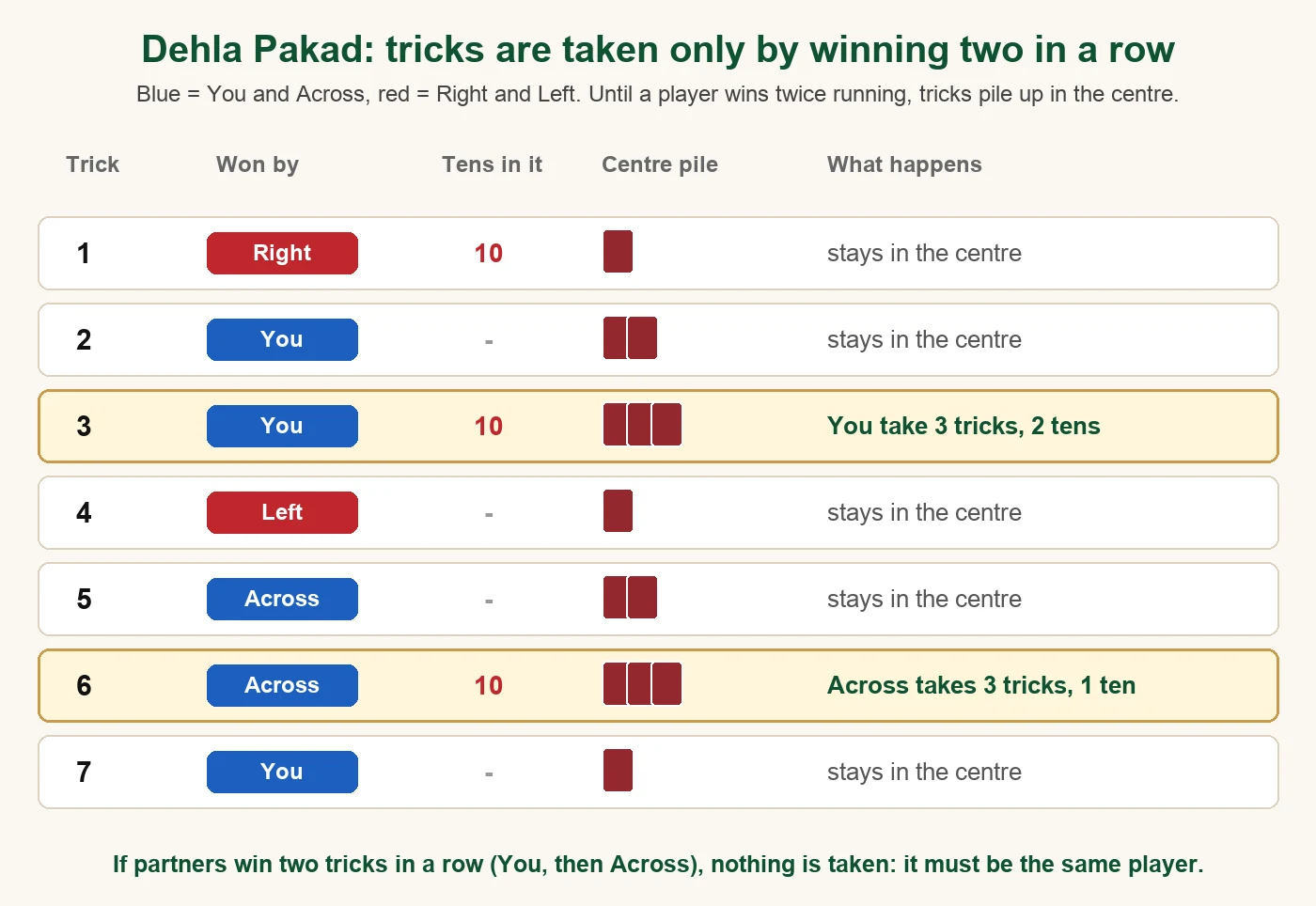
The rule turns every trick into a fight over the pile. In 10,000 computer-vs-computer hands, the centre was collected about 5 times a hand, holding 2.6 tricks on average each time.
| Tens taken | Dehla Pakad result | Who deals next |
|---|---|---|
| 4 by either side | A kot for that side | Next player to the right if the dealer’s side won it; the dealer’s partner if not |
| 2 or 3 by the non-dealing side | Non-dealers win the hand | The same dealer again |
| 3 by the dealing side | Dealer’s side wins the hand | Next player to the right |
Winning seven hands in a row also earns a kot; a kot won by taking all four tens resets that run to zero. Play for a fixed time and count kots, or play to an agreed number of kots.
Because a 2–2 split goes to the non-dealing side, the dealer’s side won only 32.9% of 10,000 simulated Dehla Pakad hands, against 52.9% in Mendicot.
These are exact probabilities for a 13-card hand from a shuffled pack, and for the 26 cards held by you and your partner together:
| Tens | In your 13 cards | Held by your side (26 cards) |
|---|---|---|
| 0 | 30.4% | 5.5% |
| 1 | 43.9% | 25.0% |
| 2 | 21.3% | 39.0% |
| 3 | 4.1% | 25.0% |
| 4 | 0.3% | 5.5% |
So your side is dealt three or four tens 30.5% of the time, and the tens are dealt 2–2 39.0% of the time. Holding a ten is not the same as keeping it, though: in 10,000 computer-vs-computer hands of Mendicot, a side captured all four tens (mendikot) in 16.3% of hands, the tens split 2–2 in 34.2%, and a 52-card mendikot happened 0.2% of the time. In Dehla Pakad, where tricks pile up and change hands in one go, a kot by four tens came in 28.5% of hands.
Six or even eight people can play as two equal teams, each player sitting between two opponents; the four twos are taken out so that the 48 remaining cards deal out evenly. Groups also differ on how trumps are chosen (see the table above) and on whether a closed trump is revealed automatically or only when a player asks for it.
For more partnership trick-taking games from India, play Twenty-Nine (29), where the trump suit stays hidden, or Callbreak, where spades are always trumps. For card games of a different kind, try Indian Rummy or read about Teen Patti.
Only three players? Try 3 2 5 (Teen Do Paanch), the Indian quota game with a 30-card pack, free to play online.
Another partnership game from India: Seep (Sweep), where you capture cards from the floor and build houses, with a free online version.
Dehla Pakad is Double Sar played for tens. The same rule, taking the centre after two tricks in a row, but counting tricks, is played in Court Piece (Rang); play both versions free online.
From Kerala: 28 (Twenty-Eight), a partnership game where the jack and nine are the top cards and trumps stay hidden until someone asks.

After going through several successful experiences with several industry pioneers, Fadi Hayek has managed to excel in the world of content for online gaming by providing unique content for several projects that allowed him to obtain the necessary experience to launch his career. Last but not least, Fadi also holds several certificates, including but not limited to content marketing and iGaming.


