Callbreak (Call Break)
Play the South Asian trick-taking game free in your browser, and learn every rule: calls, spades as trumps, scoring and house variations.


Play the South Asian trick-taking game free in your browser, and learn every rule: calls, spades as trumps, scoring and house variations.
Callbreak, also written Call Break and known as Call Bridge, is a four-player trick-taking card game popular in Nepal, India and Bangladesh. Spades are always trumps. Before each round every player makes a call: the number of tricks they expect to win. Make your call and you score it; miss it and you lose it. After five rounds, the highest total wins.
Below you can play Callbreak free against three computer players, then read the complete rules: the deal, calling, which card you are allowed to play, scoring, the common house variations and how to judge your call.

| Callbreak | |
|---|---|
| Players | 4, each playing for themselves |
| Cards | Standard 52-card pack, 13 cards each |
| Card order | A, K, Q, J, 10, 9 … 2 in every suit |
| Trumps | Spades, always |
| Call | Tricks you expect to win; usually at least 1 |
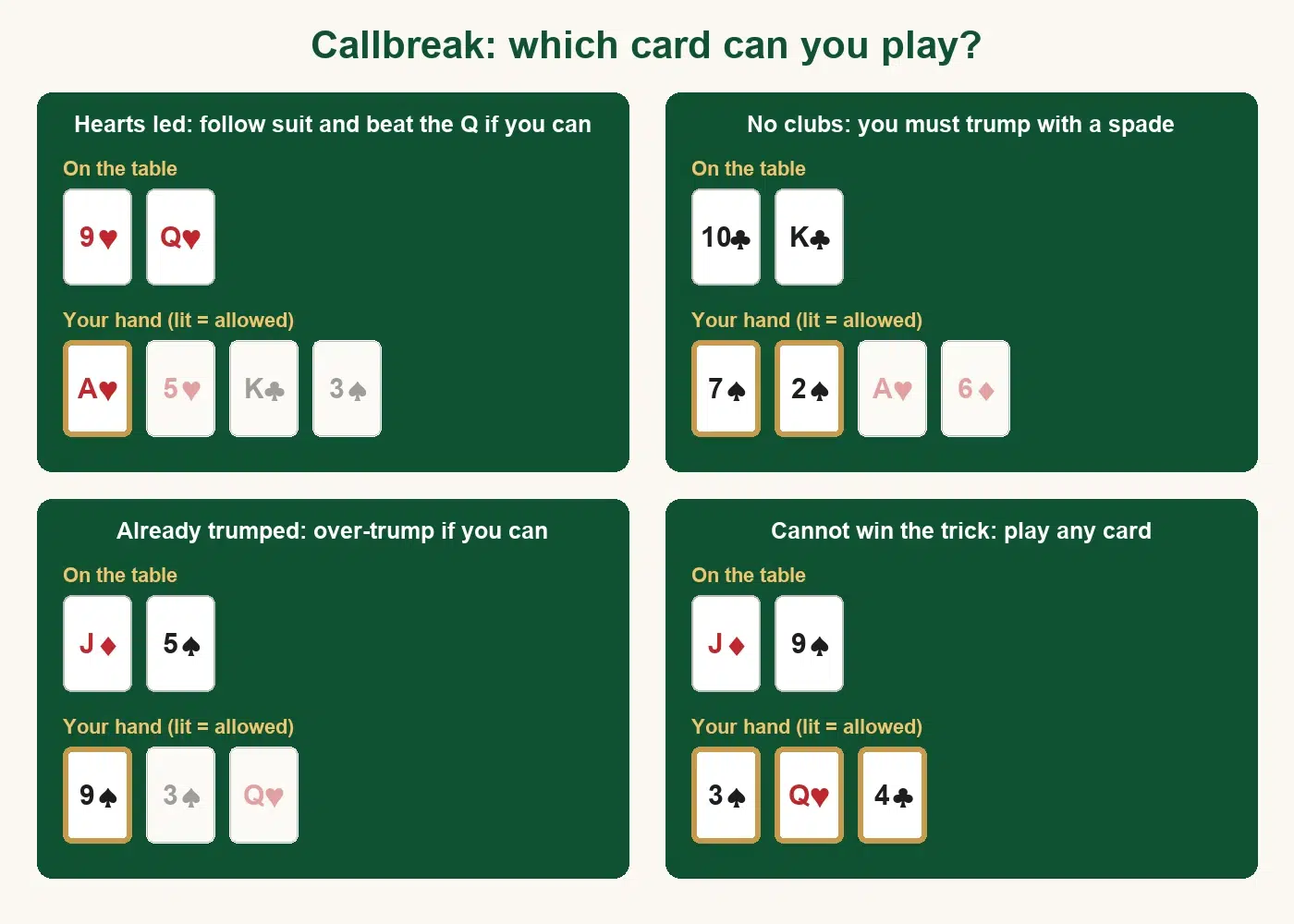
| Must | Follow suit; trump if you have no card of the suit led |
| Score | Make your call: + the call, plus 0.1 for each extra trick. Miss it: − the call |
| Game | 5 rounds (sometimes 3); highest total wins |
Each round you are dealt 13 cards. Pick your call with the number buttons, then play your cards: only the cards the rules allow you to play are lit, so the game also teaches you the rules as you go. The scoreboard keeps everyone’s calls, tricks won and running totals across the five rounds. Use Fast to speed up the computer players.
The game uses the rules found in most Callbreak apps: you must win the trick if you can, and each extra trick over your call is worth 0.1. The differences between that version and the older Call Bridge rules are set out below.
Callbreak uses a standard 52-card pack with no jokers. Cards rank from Ace (high) down to 2 in every suit, and spades are permanent trumps: any spade beats any heart, club or diamond. The dealer deals all the cards one at a time, so each player has 13. The deal passes to the next player each round. Traditional Call Bridge is dealt and played counter-clockwise; many apps go clockwise. It makes no difference to the game as long as everyone agrees.
After looking at their cards, players call in turn, starting with the player next to the dealer. A call is the number of tricks you undertake to win in this round. In most apps the lowest call is 1 and calls of up to 13 are allowed; in traditional Call Bridge the lowest call is 2. Most players keep their calls low, because a call you miss costs you the full amount.
Calls are not a contract between partners: there are no partners in Callbreak. Each player is on their own, and the four calls do not have to add up to 13.
The player next to the dealer leads the first trick, and whoever wins a trick leads the next one. Any card may be led. Then, going round the table:
The trick goes to the highest spade in it, or if there is no spade, to the highest card of the suit that was led.
Most apps add one more rule: if you can win the trick, you must. When following suit, that means playing a card higher than the best card so far, unless the trick has already been trumped. In traditional Call Bridge, a player following suit does not have to beat the cards already played. Agree which version you are playing before you start.
At the end of each round, compare the tricks each player won with their call:
| Call | Tricks won | Score |
|---|---|---|
| 4 | 4 | +4 |
| 4 | 6 | +4.2 |
| 4 | 3 | −4 |
| 3 | 5 | +3.2 |
| 5 | 3 | −5 |
| 1 | 0 | −1 |
| 2 | 7 | +2.5 |
Scores carry over from round to round, and after five rounds the player with the highest total wins. Some groups play three rounds instead.
The 0.1 for extra tricks is a tie-breaker more than a reward: calling 3 and winning 5 scores 3.2, while calling 5 and winning 5 scores 5. Calling low and taking extra tricks is the safe way to play, but it gives away points.
In the older scoring, you succeed only if you win exactly your call or one more. A call of 4 scores +4 for 4 or 5 tricks and −4 for anything else, including 6 or more. A call of 8 or more is a bonus call worth 13 points if you make it. There is no fixed number of rounds: players keep going as long as they like.
A good call is mostly about counting your sure tricks and your spades. Thirteen spades are shared among four players, so you hold 3.25 on average. The exact chances for your 13 cards:
| Spades in your hand | Chance |
|---|---|
| 0 | 1.3% |
| 1 | 8.0% |
| 2 | 20.6% |
| 3 | 28.6% |
| 4 | 23.9% |
| 5 | 12.5% |
| 6 | 4.2% |
| 7 or more | 1.0% |
So you have 4 or more spades in 41.5% of hands, and 5 or more in 17.6%. A long spade suit is valuable twice over: the high spades win tricks, and once the other players run out of spades, your small ones win too.
Call Bridge and Callbreak are the same family of game, and the names are used interchangeably; the rules differ in the details described above. The closest Western relative is Spades, which also makes spades permanent trumps and asks players to bid tricks, but is normally played in two partnerships with a different scoring system. If you enjoy calling an exact number of tricks, try Oh Hell, where the big bonus goes only to players who take exactly the number of tricks they bid.
A partnership game from the same region: Twenty-Nine (29), where the Jack and Nine are highest and the trump suit stays hidden; play it free with a computer partner.
Not a trick-taking game, but just as popular: Indian Rummy, the 13-card draw-and-discard game, with a free game to try.
A partnership game where the tens decide everything: Mendicot and Dehla Pakad, free to play against computer opponents.
A three-player game from India with fixed trick quotas: 3 2 5 (Teen Do Paanch), where whoever beats their quota pulls cards from whoever fell short; free to play against the computer.
Prefer playing in partnerships? Try Court Piece (Rang): two teams, trumps called from five cards, and courts for seven tricks in a row.

After going through several successful experiences with several industry pioneers, Fadi Hayek has managed to excel in the world of content for online gaming by providing unique content for several projects that allowed him to obtain the necessary experience to launch his career. Last but not least, Fadi also holds several certificates, including but not limited to content marketing and iGaming.


