Twenty-Nine (29) Card Game
Play the Indian partnership game free in your browser, and learn every rule: J and 9 high, bidding, the hidden trump and scoring.


Play the Indian partnership game free in your browser, and learn every rule: J and 9 high, bidding, the hidden trump and scoring.
Twenty-Nine (usually written 29) is a four-player card game played in two partnerships, partners sitting opposite each other. It is popular across northern India, including Mumbai and West Bengal, and in Bangladesh and Nepal. Only 32 cards are used, and the Jack and the Nine are the highest cards in every suit. Players bid on how many card points their side will win, the highest bidder secretly chooses trumps, and the trump suit stays hidden until somebody cannot follow suit.
Below you can play 29 free with a computer partner against two computer opponents, then read the full rules: the cards and their points, bidding, the hidden trump, the Pair, scoring with the red and black sixes, the common variations and the odds behind your first four cards.
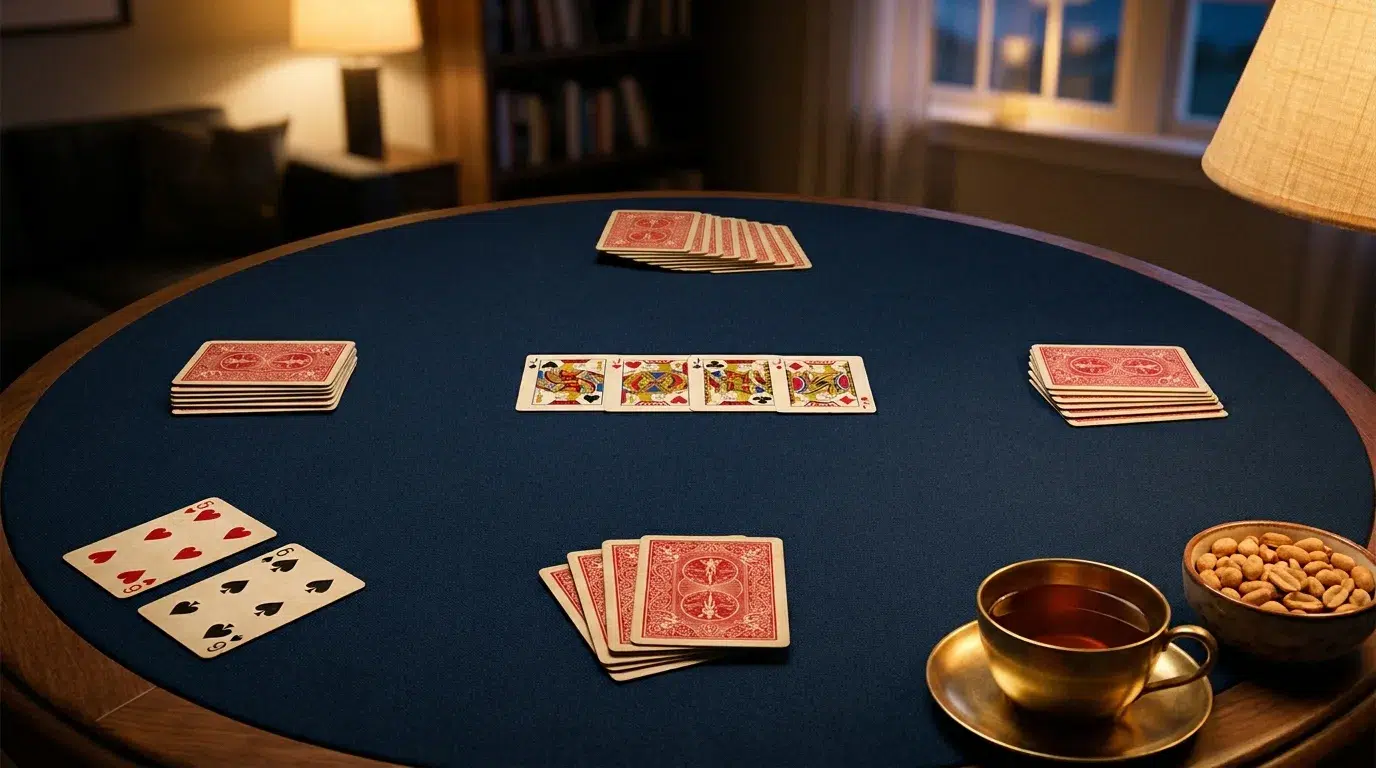
You sit at the bottom with Across as your partner; Left and Right play against you. Bid on your first four cards, choose trumps if you win the bid, then play out the eight tricks. Only the cards you are allowed to play are lit. The first side to +6 game points wins.
The game uses the most common modern rules: 28 card points (no extra point for the last trick), bids from 16 to 28, the dealer forced to bid 16 if everyone else passes, and the Pair declared automatically as soon as the side holding it wins a trick after trumps are revealed.
| Twenty-Nine (29) | |
|---|---|
| Players | 4, in two fixed partnerships (partners face each other) |
| Cards | 32: A, K, Q, J, 10, 9, 8, 7 of each suit from a standard pack |
| Card order | J, 9, A, 10, K, Q, 8, 7 in every suit |
| Card points | Jack 3, Nine 2, Ace 1, Ten 1; 28 in total |
| Deal | 4 cards each, bidding, then 4 more each (8 cards) |
| Bids | 16 to 28 in most games (15 to 28 in some) |
| Trumps | Chosen secretly by the highest bidder; revealed when a player cannot follow suit |
| Scoring | +1 game point if the bidding side makes its bid, −1 if not |
| Game | First side to +6 wins; a side at −6 loses |
| Direction | Clockwise (counter-clockwise in some regions) |
Twenty-Nine uses 32 cards: the 2s to 6s are taken out of a standard 52-card pack. The cards in every suit rank, from high to low: J, 9, A, 10, K, Q, 8, 7. The same eight cards also carry the points that decide each hand:
| Card | Points each | In the pack |
|---|---|---|
| Jack | 3 | 4 × 3 = 12 |
| Nine | 2 | 4 × 2 = 8 |
| Ace | 1 | 4 |
| Ten | 1 | 4 |
| King, Queen, 8, 7 | 0 | 0 |
| Total | 28 |
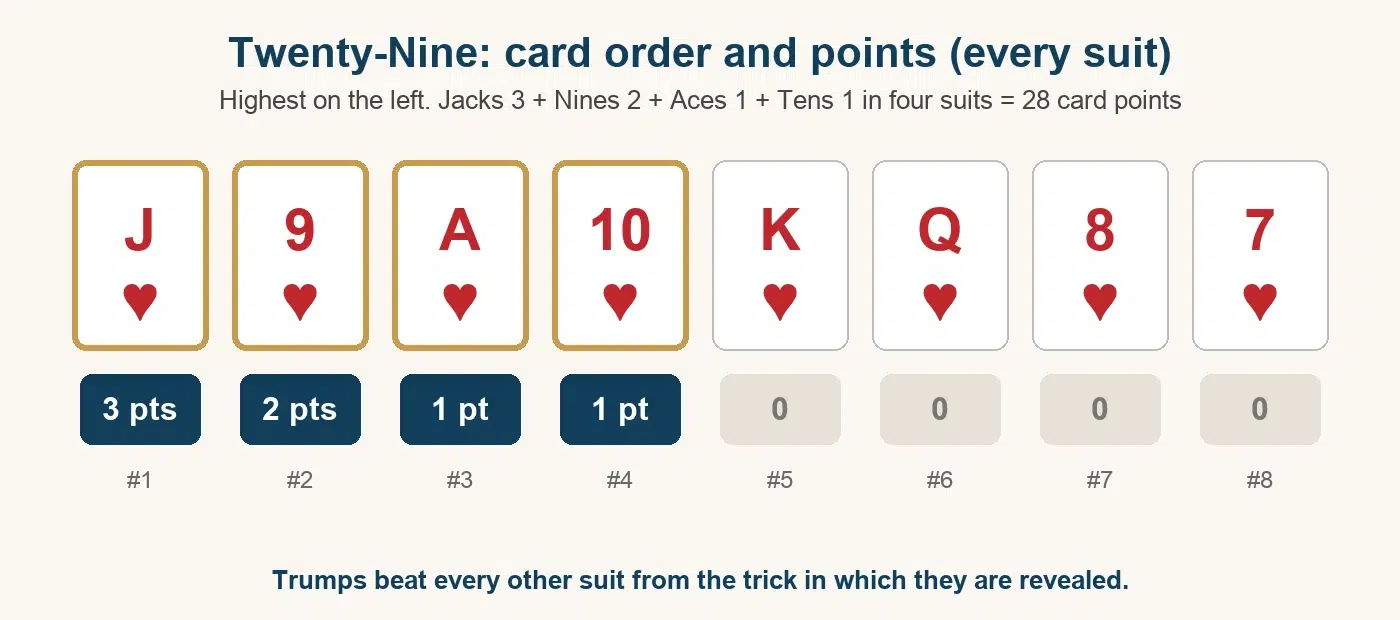
The cards left over have jobs of their own in a traditional game. The 2s to 5s are used as trump indicators, and each partnership keeps its score with one red and one black Six.
In some versions the last trick is worth an extra point, which makes 29 points in all; with that point the highest bid is 29, which explains the name. Most players nowadays do not count the point for the last trick, but still call the game 29. Another explanation you will hear: with a bid of 16 and 28 points in play, the opponents need 13 to defeat it, and 16 + 13 = 29.
The player to the dealer’s left leads to the first trick. Everyone must follow suit if they can, and the winner of each trick leads to the next. What makes 29 different from most trick-taking games is that nobody except the bidder knows which suit is trumps.
The King and Queen of trumps together are called the Pair or Royals. After trumps have been revealed, a player holding both can declare them straight after their own side wins a trick (the trick in which trumps were revealed, or any later trick). Both cards must still be in the player’s hand.
| Who declares the Pair | Effect on the bidding side’s target | Example: bid 20 |
|---|---|---|
| The bidder or the bidder’s partner | 4 points fewer, but not below the lowest bid (16, or 15) | Target becomes 16 |
| An opponent of the bidder | 4 points more, up to a maximum of 28 | Target becomes 24 |
A player holds both the King and Queen of one particular suit in about 5.6% of deals, so for any given trump suit one of the four players holds the Pair in roughly 22.6% of deals.
After all eight tricks, each side counts the card points in the tricks it won. If the bidding side took at least as many points as it bid (adjusted for a Pair), it wins one game point; otherwise it loses one. The other side’s score does not change.
Each side keeps its score with a red Six (called nali or red chaka) and a black Six (kala or black chaka). Red pips showing are a plus score, black pips a minus score. The first side to reach +6 wins the game, and a side that falls to −6 loses it.
| Hand | Bid | Bidding side’s points | Result |
|---|---|---|---|
| 1 | 17 by your side | 19 | Bid made: your side +1 |
| 2 | 18 by the opponents | 15 | Bid missed: opponents −1 |
| 3 | 20 by your side, Pair declared by your partner | 17 | Target 16, made: your side +1 (now +2) |
| 4 | 16 by the opponents, Pair declared by your side | 18 | Target 20, missed: opponents −1 (now −2) |
Rules differ from region to region and from family to family, so agree them before the first deal. These are the ones you are most likely to meet:
| Variation | What changes |
|---|---|
| Point for the last trick | The last trick earns 1 extra card point (29 in all), and bids go up to 29. |
| Lowest bid 15 or 16 | Some play a minimum of 15, others 16; a Pair cannot take the bidding side below the minimum. |
| Counter-clockwise | Played in some regions: the player to the dealer’s right bids first and leads. |
| No trumps | A Joker added to the indicator cards lets the bidder choose No Trumps; no Pair can then be declared. |
| Reverse | A 2 as the indicator means No Trumps with the order reversed (7 high, Jack low); points stay the same. Popular in West Bengal. |
| Seventh card | A bidder who cannot pick a suit from four cards calls for the “seventh card”: the bidder’s seventh card, dealt in the second round, sets trumps. |
| Double and redouble | An opponent can double before the second deal (2 game points won or lost); the bidding side can redouble (4). |
| Single hand | A player with a very strong hand undertakes to win all eight tricks alone, with no trumps: 3 game points won or lost. |
| Under half | In Bengal, Bihar and Jharkhand many play that a bidder who takes less than half the bid loses double. |
| Bangladesh rules | If either of the first two players has no points in their first four cards, the deal is thrown in. |
You bid after seeing only half your hand, so it helps to know what four cards usually look like. These are exact probabilities for a random four-card hand from the 32-card pack (checked by a 200,000-deal simulation):
| In your first four cards | Chance |
|---|---|
| No points at all (only K, Q, 8, 7) | 5.1% |
| At least one Jack | 43.1% |
| Two or more Jacks | 6.6% |
| Two Jacks, or a Jack and the Nine of the same suit | 10.5% |
| 3 card points or fewer | 52.5% |
| 6 card points or more | 16.6% |
| Average card points | 3.5 (one-eighth of 28) |
The practical meaning: a hand worth a confident bid is rarer than it feels. Only about one hand in ten (10.5%) holds two Jacks or a Jack with the Nine of the same suit, and the minimum bid of 16 already commits your side to more than half of the 28 points.
If you like partnership games with trumps and bidding, try Callbreak, where spades are always trumps and everyone plays alone, or its American cousin Spades. For a quick three-card game from the same part of the world, read our guide to Teen Patti.
Another card game from India: 13-card Indian Rummy, where you need two sequences, one of them pure, to declare; play it free against the computer.
Another partnership game from India: Mendicot (Mendikot) and Dehla Pakad, where the aim is to capture the four tens; play both free with a computer partner.
For three players: the 3 2 5 card game, played with a 30-card pack and quotas of 5, 3 and 2 tricks, with a free online version.
A different kind of partnership game: Seep, the north Indian capturing game of houses and sweeps, free to play against the computer.
Another partnership trick game from India and Pakistan: Court Piece (Rung), where the first side to seven tricks wins and seven in a row scores a court.
The Kerala cousin of 29: 28 (Twenty-Eight) from Kerala uses the same cards and points, but the bidder hides one of their own cards as the trump and bids start at 14; play it free online.

After going through several successful experiences with several industry pioneers, Fadi Hayek has managed to excel in the world of content for online gaming by providing unique content for several projects that allowed him to obtain the necessary experience to launch his career. Last but not least, Fadi also holds several certificates, including but not limited to content marketing and iGaming.


