Donkey Card Game
Play Getaway and the Kerala Donkey free in your browser and learn every rule: the ace of spades, the thulla, getting away and who ends up the donkey.


Play Getaway and the Kerala Donkey free in your browser and learn every rule: the ace of spades, the thulla, getting away and who ends up the donkey.
The Donkey card game is a family favourite in India: everyone tries to get rid of their cards, and the last player still holding cards is the donkey. In Punjab, Pakistan and Bangladesh the same game is known as Getaway, and its key move is the thulla, a card of another suit that stops a trick and makes someone pick the whole trick up. In Kerala it is played with a trump suit and called Donkey.
Play both versions free below against three computer players, then read the full rules: the deal, the first trick with the ace of spades, following suit, the thulla, getting away, the Kerala trump rules, who ends up the donkey, house rules, odds and tips. At the end there is a short guide to the other card games that are also called Donkey.
You sit at the bottom; Left, Across and Right are computer players, and play goes to the left. Pick Getaway (no trumps) or Donkey (Kerala, with trumps) at the top. Only the cards you are allowed to play are lit. The table shows how many cards each player holds, a tick once they have got away, and how many times each player has been the donkey.
The free game uses the standard rules described below, with one optional rule left out: taking all the cards of the player on your left.
| Getaway (Punjab) | Donkey (Kerala) | |
|---|---|---|
| Players | 3 to about 8 (4 is common) | 3 to about 8 (4 is common) |
| Cards | Standard 52-card pack, no jokers, A high | Standard 52-card pack, no jokers, A high |
| Deal | All the cards, as evenly as possible | All the cards, as evenly as possible |
| Direction | Clockwise | Clockwise |
| First lead | The ace of spades | The ace of spades |
| Trumps | None | Set by the first player who cannot follow suit |
| Cannot follow suit | Play any card: a thulla, which ends the trick | Play a trump if you can; otherwise any card, which ends the trick |
| Who picks up | The highest card of the suit led | The winner of the trick (highest trump, or highest card of the suit led) |
| Aim | Get rid of all your cards | Get rid of all your cards |
| Loser | The last player holding cards | The last player, a “donkey with x legs” (x = cards left) |
Use a standard 52-card pack without jokers. Cards in each suit rank from high to low A, K, Q, J, 10, 9, 8, 7, 6, 5, 4, 3, 2. At least three players are needed for the game to be interesting, and up to about eight can play. With four players everyone gets 13 cards.
Shuffle and deal out all the cards as equally as possible; some players may get one more card than others. Deal and play go clockwise. Players pick up their cards and keep them hidden. Taking turns to deal evens out the luck of getting an extra card.
The player holding the ace of spades starts by playing it face up, and every other player must also play a card. Players who have a spade must play a spade of their choice; players with no spades may play any card. In this first trick, unlike the rest of the game, a card of another suit does not stop anyone else from playing.
When everyone has played, the cards of the first trick are put face down to one side to start a discard pile (the waste pile). They are always thrown away, even if someone could not follow suit. The player of the ace of spades leads to the second trick (in the Kerala game, the player of the highest trump if one was played).
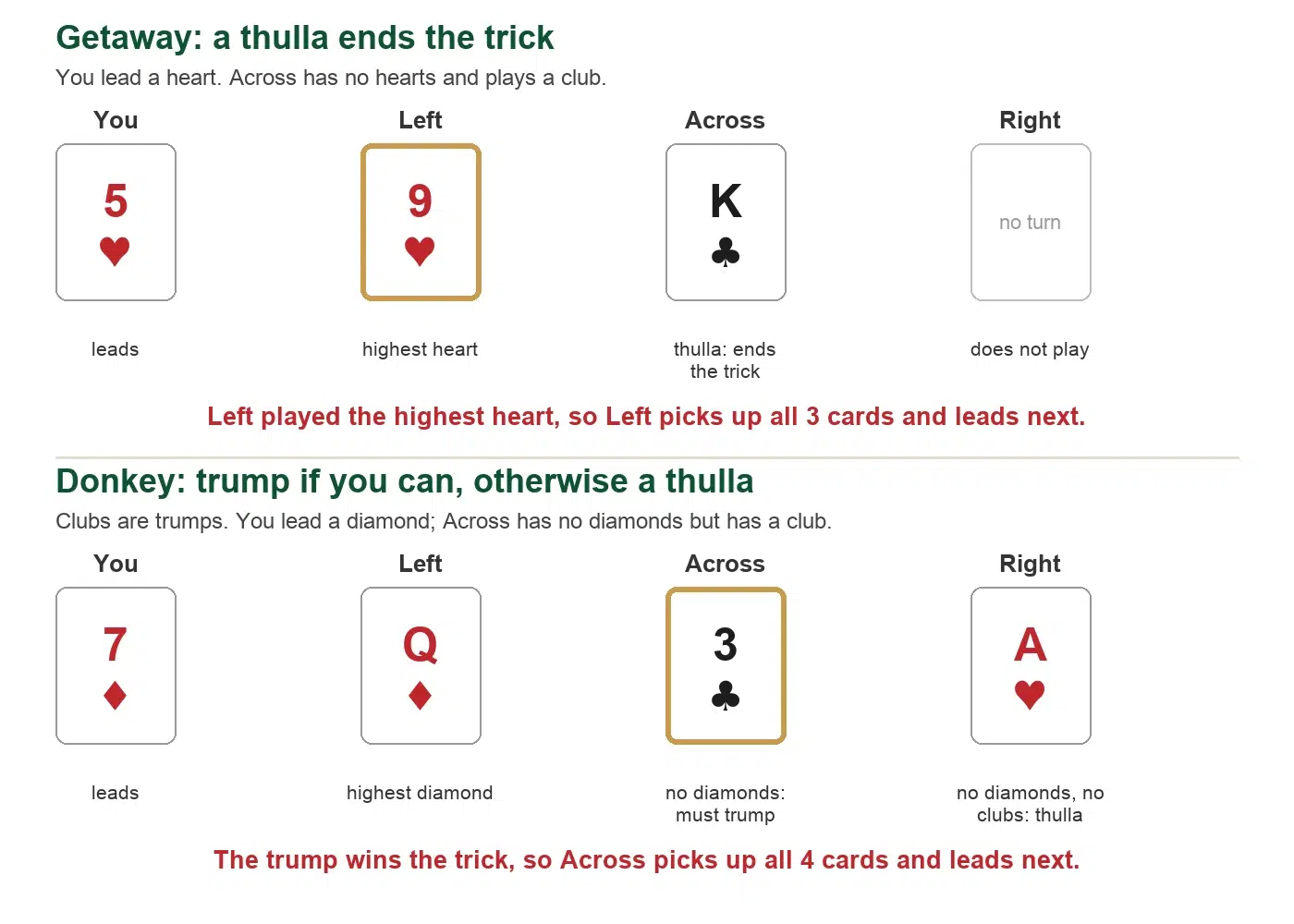
The word thulla is Hindi slang for the police, used for the card that interrupts the trick. Mistakes have a price too: anyone who plays to a trick after the thulla, plays out of turn, or plays a thulla while holding the suit led has to pick up the trick and lead next.
As tricks are thrown away or picked up, players run out of cards at different times. A player who has no cards left has got away: they take no more part in the game and cannot lose.
There is one catch. You cannot get away while you have the power. If your last card is the highest card in a trick where everyone followed suit, it is your turn to lead but you have nothing to lead with. You must then draw a card at random from the shuffled discard pile, before the cards of the trick just played are added to it, and lead that card. If somebody plays higher in that suit, you are out; if not, you have to lead again.
Before any trick, a player may take all the cards of the player on their left (or, if that player has none, the next player clockwise who still has cards) and add them to their own hand. The player who gave up their cards has got away and cannot lose. It sounds strange in a game about getting rid of cards, but it is often the best move when the player on your left does not have the suits you hold, or has the low cards you need.
As players get away and drop out, the last player still holding cards is the loser, the donkey. There is no formal scoring; when you play a series of games, simply keep count of how often each player has been the donkey. In the Kerala game the loser is called a “donkey with x legs”, where x is the number of cards they are left holding.
Play goes on as normal. If one of the two plays their last card as a thulla, or their last card is the same suit and lower than the other player’s card, the player still holding cards is the donkey. If you lead your last card and your opponent beats it with a higher card of the same suit, you get away and your opponent loses, even if that was their last card too.
In Kasaragod, Kerala, the game called Donkey adds a trump suit. Everything else is played as in Getaway: the ace of spades leads to the first trick, you must follow suit if you can, and the last player holding cards loses.
Trumping makes the Kerala game faster: in 10,000 computer-played games of each version, a game of Donkey lasted 18 tricks on average with 4.5 pick-ups, against 25 tricks and 12.5 pick-ups in Getaway. The donkey was left with 3.7 legs (cards) on average, and never more than 15.
In Punjab many players call the game Bhabhi or Bhabhi Thulla. That name is used to mock the loser and many find it offensive, which is why this page uses Getaway and Donkey.
| With four players and 13 cards each | Chance |
|---|---|
| You hold the ace of spades and lead the first trick | 25% |
| A given player is dealt no spades | 1.3% |
| At least one player has no spades, so the first trick has an off-suit card (in Donkey it makes trumps straight away) | 5.1% |
| Your 13 cards are missing at least one suit | 5.1% |
From 10,000 computer-played games of each version:
| Getaway | Donkey (Kerala) | |
|---|---|---|
| Average length | 25.4 tricks | 18.0 tricks |
| Average pick-ups per game | 12.5 | 4.5 |
| Games where someone had to draw from the discard pile | 13.0% | 45.7% |
| The ace-of-spades holder ended up the donkey | 34.4% | 22.8% |
With four players each would be the donkey 25% of the time if it were pure chance. In Getaway the player who starts with the ace of spades lost more often than that (34.4%).
The name is used for several quite different children’s and party games, so check which one your group means:
More card games from India to play free on this site: Callbreak, 3 2 5 (Teen Do Paanch), 29 (Twenty-Nine), Mendicot and Dehla Pakad and Indian Rummy.
Another favourite from Indian card nights: Bluff, the face-down shedding game where you call a rank and anyone can shout Bluff; free to play online.

After going through several successful experiences with several industry pioneers, Fadi Hayek has managed to excel in the world of content for online gaming by providing unique content for several projects that allowed him to obtain the necessary experience to launch his career. Last but not least, Fadi also holds several certificates, including but not limited to content marketing and iGaming.


