Bluff Card Game
Play Bluff free in your browser against three computer players and learn every rule: naming a rank, passing, calling Bluff, who picks up the pile and how to win.


Play Bluff free in your browser against three computer players and learn every rule: naming a rank, passing, calling Bluff, who picks up the pile and how to win.
Bluff is the card game where you get rid of your cards by playing them face down and saying what they are, and nobody can see whether you are telling the truth. The first player to start a round names a rank, everyone else claims to play cards of that same rank, and anyone who thinks a claim is false shouts “Bluff!”. Whoever is wrong picks up the whole pile.
It is the version of I Doubt It played across India, where pagat.com records it from West Bengal. It is a close cousin of Cheat (Bullshit), but in Cheat the rank goes up by one every turn, while in Bluff everyone plays the same rank until the round ends. Play Bluff free below against three computer players, then read the full rules, the variations, the odds and some tips.

You sit at the bottom; Left, Across and Right are computer players and play goes clockwise. When you lead, tap one or more cards and then tap the rank you want to call. On your turn, tap the cards you want to put down and press Play (they do not have to be the rank called), or press Pass. After another player’s play you are asked whether you believe it: press Bluff! to turn their cards over, or Believe it to let it stand. The table shows how many cards everyone holds and who has passed.
In the free game each player gets 13 cards, the players are asked in turn order (starting with the next player) whether they want to call Bluff, only the cards from the last play are turned over, and the game ends as soon as one player has played their last cards without being caught. The first lead moves one seat to the left each game.
| Bluff | |
|---|---|
| Other names | I Doubt It, Bluff (India); close relatives: Cheat, Bullshit, Verish’ ne Verish’ |
| Players | 3 or more; 3 to 6 is best (with many players some use two packs) |
| Cards | One standard 52-card pack, all dealt out (some add jokers as wild cards) |
| Aim | Be the first to get rid of all your cards |
| A turn | Play one or more cards face down claiming the rank in force, or pass |
| Passing | Out for the rest of the round, but you can still call Bluff |
| Calling Bluff | The last play is turned over; whoever was wrong picks up the whole pile |
| Direction | Clockwise |
Shuffle a standard 52-card pack and deal all the cards out one at a time; with four players everyone gets 13. Keep your cards hidden, but the number of cards each player holds should stay visible to everyone. Agree who leads first: many groups start with the player holding the ace of spades.
The first player puts one or more cards face down in the middle and names a rank, for example “three sevens”. Suits do not matter, only the rank, and the cards may or may not really be sevens. That rank now has to be followed until the round is over.
Going clockwise, each player either plays one or more cards face down on the pile, claiming they are all of the rank in force (“two sevens”), or passes. A player who passes cannot put down cards again in that round, but can still call Bluff. Play keeps going round the table, skipping players who have passed. If everyone else has passed, the last player can keep adding cards to the pile on their own.
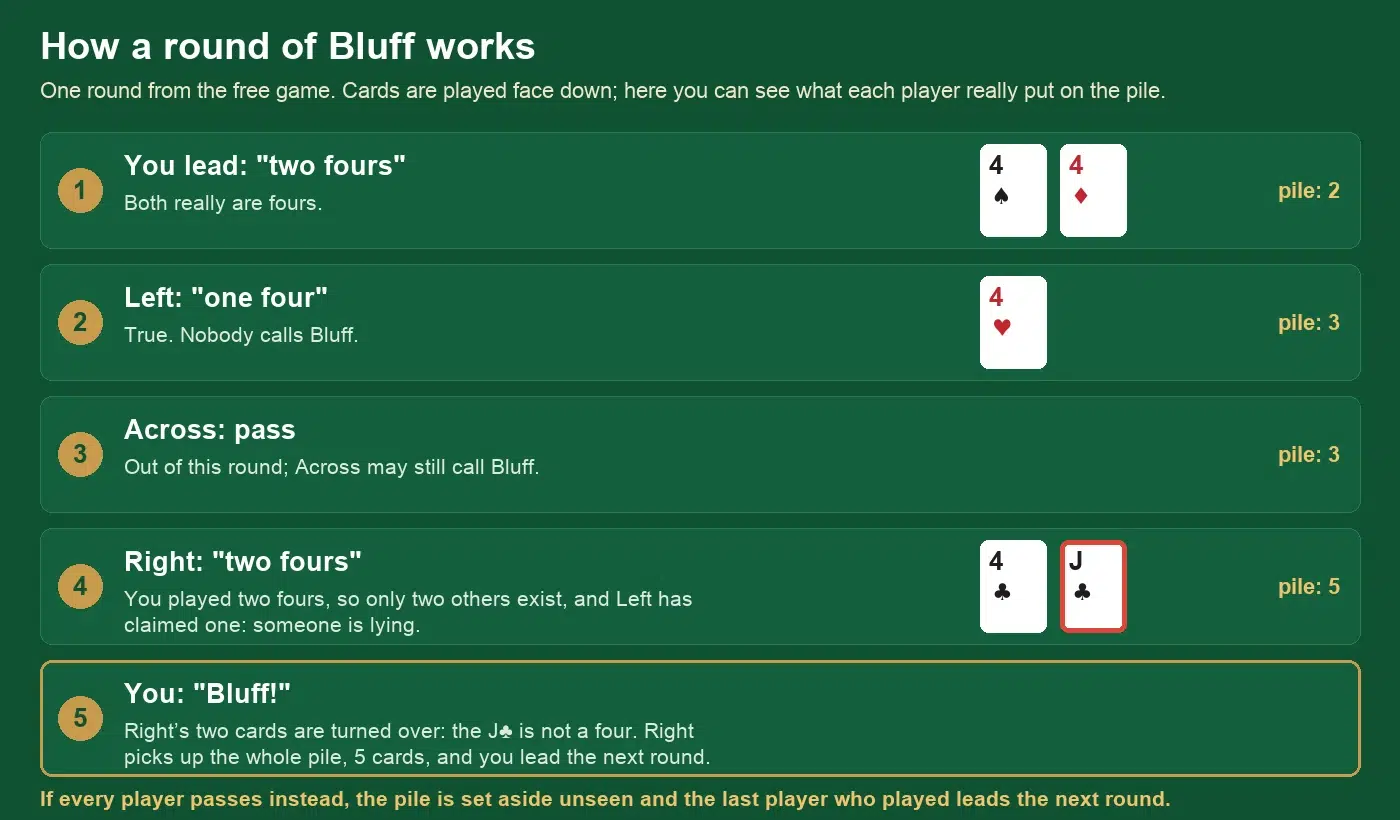
After any play, and before the next cards go down, any other player can call “Bluff!” on it; you do not have to wait for your turn. The cards from that last play are turned over:
| When the cards are turned over | Who picks up the pile | Who starts the next round |
|---|---|---|
| At least one card is not the rank in force | The player who played them | The player who called Bluff |
| Every card is the rank in force | The player who called Bluff | The player who played them |
The player who picks up takes the whole pile, not just the last play. The round is over, and the new leader can name any rank.
If every player passes, the pile is put aside without being turned over and is out of the game. The last player who put cards on it starts the next round with any rank.
The first player to get rid of all their cards wins. Your last play can still be challenged: if someone calls Bluff and you were lying, you pick up the pile and the game goes on; if you told the truth, the challenger picks up and you have won. Many groups do not stop there but play on for places: the next player out comes second, and so on, until one player is left holding cards and loses.
Both games are about playing cards face down and lying about them, and both are sometimes called I Doubt It, but the turn works differently:
| Bluff (same rank) | Cheat (rising rank) | |
|---|---|---|
| Which rank you claim | The rank named by the player who started the round, until the round ends | The next rank up every turn: aces, twos, threes and so on |
| Can you pass? | Yes; you are out for the rest of the round but can still call Bluff | No: every turn you put down one or more cards |
| After a challenge | The round ends; the player who was right starts a new round with any rank | Play carries on to the next player with the next rank |
| When everyone passes | The pile is set aside unseen | Does not happen |
| What you shout | “Bluff!” | “Cheat!”, “Bullshit!” or “I doubt it!” |
Because the leader picks the rank in Bluff, starting rounds matters a lot more than in Cheat, where you cannot choose what to call.
There are only four cards of each rank, so counting is the best lie detector in Bluff. With four players and 13 cards each, this is how many cards of any one rank you hold at the deal:
| Cards of a rank in your 13 | Chance |
|---|---|
| 0 | 30.4% |
| 1 | 43.9% |
| 2 | 21.3% |
| 3 | 4.1% |
| 4 | 0.3% |
So for a rank someone else names, you have none of it 30% of the time and you have to bluff or pass. About half of all hands (49%) hold three or four cards of at least one rank, which makes a good rank to lead; a full four of a kind comes up in only 3.4% of hands. On average you hold none at all of about 4 of the 13 ranks.
Your own cards tell you how likely another player’s claim is. This is the chance that one particular opponent really holds the cards at the deal:
| You hold of that rank | Opponent has 1+ | Opponent has 2+ | Opponent has 3+ |
|---|---|---|---|
| 0 | 81.8% | 40.7% | 9.9% |
| 1 | 71.6% | 25.3% | 3.1% |
| 2 | 56.1% | 10.5% | impossible |
| 3 | 33.3% | impossible | impossible |
Two cards of a rank in one opposing hand is less likely than not even when you hold none (41%), and with two in your own hand it drops to 11%. Count the cards of that rank you know are real (the ones in your hand plus any you truly played) and add the other players’ claims: if the total is more than four, someone is lying for certain, although it may not be the player who just played.
In 20,000 games between the free game’s computer players, the player who leads the first round won 28% of games, against about 24% for each of the others, a game lasted 46 plays on average, there were about 11 calls of Bluff a game, 58% of them caught a liar, and the loser of a challenge picked up 3.8 cards on average.
Like Bluff? Try Cheat with its rising ranks, the dice bluffing game Liar’s Dice, the signalling game Kemps, or the Indian trick game Donkey. All of them are listed on the casino games page.

After going through several successful experiences with several industry pioneers, Fadi Hayek has managed to excel in the world of content for online gaming by providing unique content for several projects that allowed him to obtain the necessary experience to launch his career. Last but not least, Fadi also holds several certificates, including but not limited to content marketing and iGaming.


