Liar's Dice Rules
Roll under the cup, bid on the whole table, call the bluff: how to play liar's dice and Perudo, and how to read the odds.


Roll under the cup, bid on the whole table, call the bluff: how to play liar's dice and Perudo, and how to read the odds.

Liar’s dice is a bluffing game for two or more players. Everyone rolls five dice under a cup and looks only at their own. Players then take turns bidding on how many dice of one number are on the whole table, each bid higher than the last, until someone calls “liar”. The cups come up, the loser of the challenge gives up a die, and the last player with dice left wins. It is also played as Perudo or Dudo, where ones are wild. This guide covers the liar’s dice rules, the Perudo rules, the poker-dice version, and the odds that tell you when a bid is likely to be true.
| Liar’s dice | |
|---|---|
| Players | Two or more; best with four to six. |
| Equipment | Five standard dice and a dice cup for each player. |
| A bid | A quantity and a face: “seven threes” means at least seven threes among all the dice on the table. |
| Your turn | Make a higher bid, or call “liar” on the last one. |
| Wild ones | In Perudo, and in many house games, a one counts as any face being bid. |
| Losing a die | Whoever is wrong when a bid is challenged loses one die. |
| Winning | The last player with dice left wins. |
| Also called | Perudo, Dudo, Cacho, pirate’s dice, Call My Bluff, Bluff. |
Agree this before you start. The three common rules are:
Four players. The first bids “three fours”, the second raises to “five fours”, and the third to “seven fours”. The fourth player calls. Under the cups there are six fours, so the bid of seven was wrong: the third player loses a die. With seven or more fours, the caller would have lost one instead.
Perudo (also called Dudo) is the South American form of liar’s dice. It plays as above, with these extra rules:
The other classic version passes one set of five dice around the table. You roll in secret and announce a poker-dice hand: a pair, two pair, three of a kind, a straight, a full house, four or five of a kind. It may be true or a bluff. Rule books rank straights differently, so agree the order first. The next player either calls it, or accepts the dice unseen, rerolls any of them (saying how many) and must announce a higher hand. Whoever is wrong when a call is made loses a counter; the last player with counters wins.
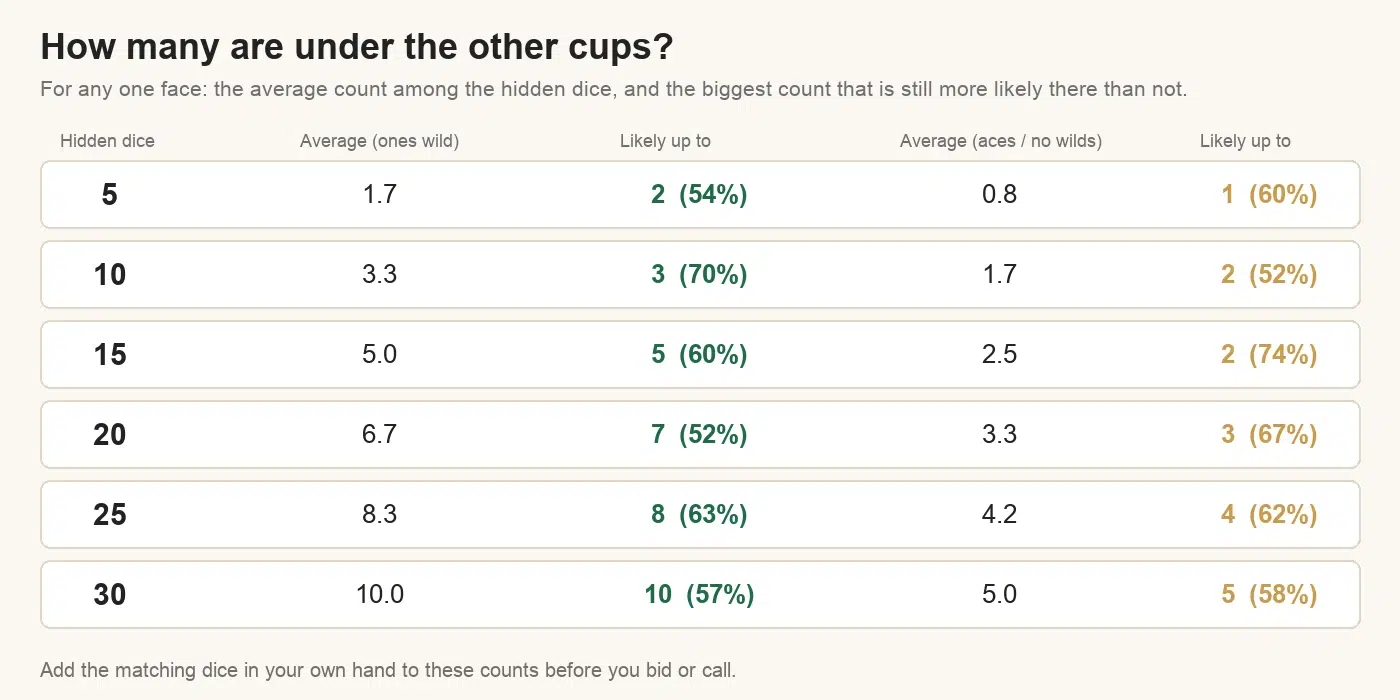
You cannot see other players’ dice, but you can work out what is likely under their cups. Each hidden die shows a given face one time in six. With ones wild, any face from two to six is matched one time in three. So:
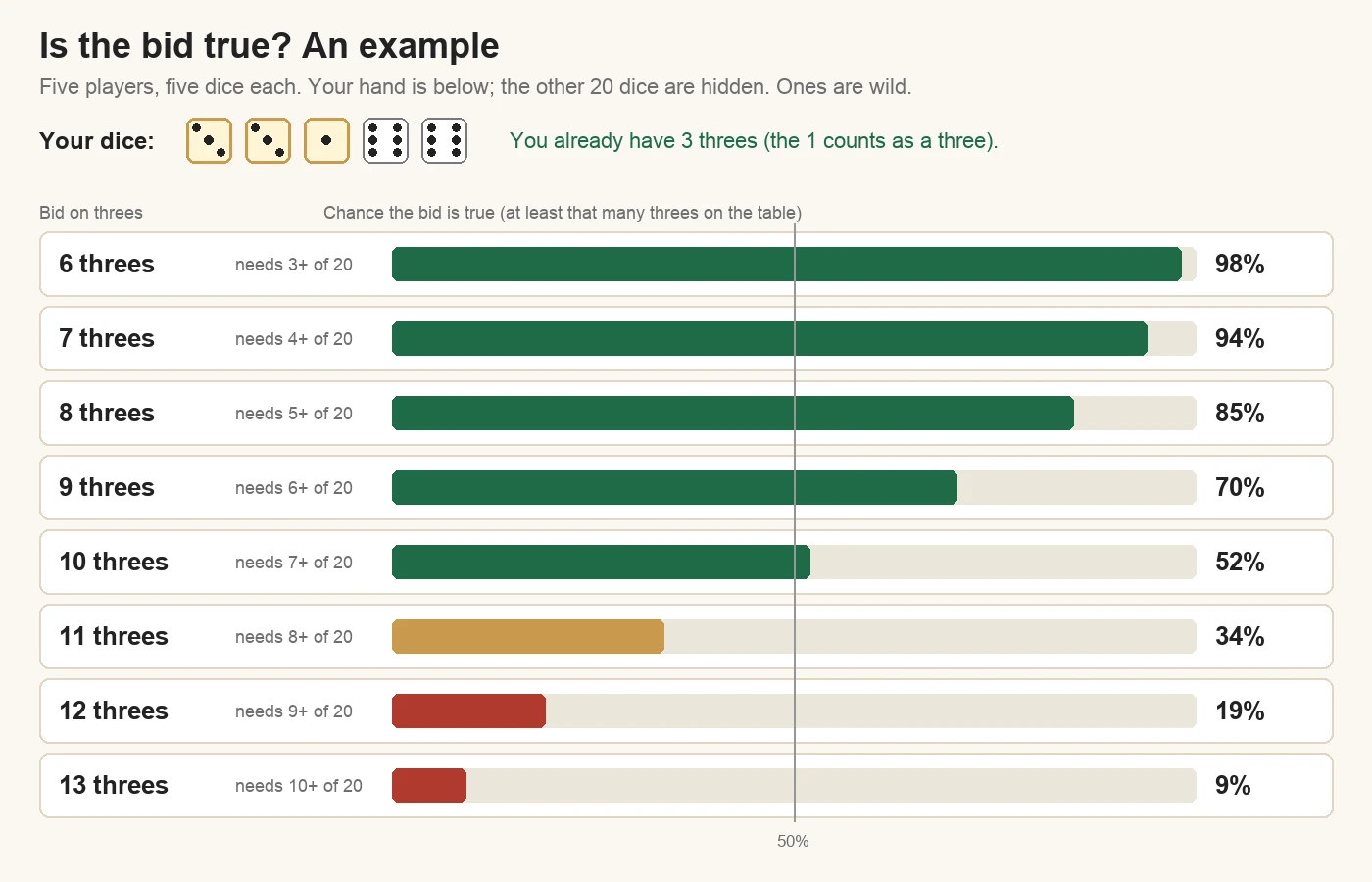
In the example above you hold 3, 3, 1, 6, 6, so you have three threes (and three sixes) already. The other 20 dice should hold about 6.7 more threes, making about ten in all. “Nine threes” is true 70% of the time and “ten threes” 52%; by “twelve threes” it is down to 19%, and that is the bid to call.
Liar’s dice is said to come from Dudo, a game from the Inca Empire in the 15th century, carried to Europe by Spanish conquistadors; it is still widely played across South America under names such as Cacho and Dudo. Many commercial versions followed in the 1970s and 1980s, and Call My Bluff (sold as Bluff) won Germany’s Spiel des Jahres in 1993. Film fans know it from the dice game in Pirates of the Caribbean: Dead Man’s Chest, and gamers from Red Dead Redemption.
For more dice, try Farkle, the six-dice push-your-luck game, or the pub classic Shut the Box. If it is the bluffing you enjoy, Three Card Brag and poker are built on it.
If you play for money, agree the stakes in advance and keep them small. Free, confidential support is available at BeGambleAware.org. 18+ only.
The card version of the bluff: Cheat (also called Bullshit or I Doubt It), where you play face down and dare others to call it.
Another game played for counters: Newmarket (Boodle), the classic stops game with four horses.
For a bigger group: Bunco, the party dice game where three of the round number scores 21.
Another bar dice game: Ship, Captain and Crew, where you race to roll a 6, 5 and 4 and score the cargo.
A lighter dice game: Pass the Pigs, first to 100 points wins.
A dice game without the bluffing: Yahtzee, plus a printable score card.
A dice game for betting against a banker: Cee-lo, played with three dice.
Bluffing with cards instead of dice: in Bluff you play cards face down and claim a rank; call Bluff and whoever was wrong picks up the pile. Free to play online.

After going through several successful experiences with several industry pioneers, Fadi Hayek has managed to excel in the world of content for online gaming by providing unique content for several projects that allowed him to obtain the necessary experience to launch his career. Last but not least, Fadi also holds several certificates, including but not limited to content marketing and iGaming.


