Snakes and Ladders
Play snake and ladder free online against the computer, choose your house rules, and learn the rules, the odds and the history of Moksha Patam.


Play snake and ladder free online against the computer, choose your house rules, and learn the rules, the odds and the history of Moksha Patam.
Snakes and ladders (in India Saanp Seedhi or Moksha Patam) is the race game everyone learns as a child. Roll a die, move your counter up a board of 100 squares, climb every ladder you land on and slide down every snake. The first player to reach square 100 wins.
Play it free below against one, two or three computer players, with the house rules you grew up with. Then read the rules step by step, the variations, the exact odds of how long a game lasts, and the story of how a game of Indian philosophy became a nursery classic.
You are red and go first. Press Roll; the computer players roll for themselves. Choose how many computer players you want and the two house rules most families argue about: whether you need a 6 to start, and whether you need an exact roll to land on 100.
In the free game a 6 always gives another roll, as in the traditional rules. With “Exact roll” a roll that would take you past 100 is not moved; with “Any roll” reaching or passing 100 wins. The board has 8 ladders and 8 snakes, laid out for this page.
| Snakes and ladders | |
|---|---|
| Other names | Saanp Seedhi, Saanp aur Seedhi, Moksha Patam, Mokshapat, Parama Padam, Vaikunthapali, Chutes and Ladders |
| Players | 2 or more |
| Equipment | A board (usually 10 by 10 squares), one die, a counter for each player |
| Aim | Be the first to reach the last square, 100 |
| Ladders | Land at the bottom: climb to the top |
| Snakes | Land on the head: slide down to the tail |
| Extra roll | A 6 gives you another roll |
| Skill | None: the game is pure luck |
| Game length | One player needs about 38 rolls on average on the board below; a game takes 15 to 45 minutes |
| Rule | How it is played | Effect on the game |
|---|---|---|
| Need a 6 to start | Your counter stays off the board until you roll a 6. | One player’s average rises from 38.5 to 43.8 rolls on the board below. |
| Exact roll to finish | If your roll would take you past 100, you do not move. | Average 46.0 rolls instead of 38.5. |
| Bounce back | If your roll is too big, count up to 100 and back down the rest. Needing 3 and rolling 5 puts you on 98. | You can end up further away than before, and on a snake near the top. |
| Both rules together | Need a 6 to start and an exact roll to finish. | The longest version: 51.4 rolls on average. |
| Two dice | Roll two dice and move the total, for a quicker game. | Fewer turns; a double gives the extra roll instead of a 6. |
| Bigger or smaller boards | The grid is most often 10 by 10, but 8 by 8 and 12 by 12 boards exist. | Longer or shorter games. |
The board has 8 ladders and 8 snakes. No ladder ends on a snake’s head and no snake ends at the foot of a ladder, so every move has at most one jump. The table shows how often a single player, on average, uses each one in a game played with the exact-finish rule.
| Snake or ladder | Squares gained or lost | Times used per game (average) |
|---|---|---|
| Ladder 3 → 22 | +19 | 0.23 |
| Ladder 8 → 30 | +22 | 0.28 |
| Ladder 21 → 42 | +21 | 0.49 |
| Ladder 28 → 55 | +27 | 0.37 |
| Ladder 36 → 57 | +21 | 0.29 |
| Ladder 50 → 69 | +19 | 0.62 |
| Ladder 71 → 92 | +21 | 0.62 |
| Ladder 80 → 99 | +19 | 0.39 |
| Snake 27 → 5 | −22 | 0.37 |
| Snake 47 → 16 | −31 | 0.79 |
| Snake 56 → 37 | −19 | 0.57 |
| Snake 66 → 45 | −21 | 0.61 |
| Snake 74 → 53 | −21 | 0.69 |
| Snake 89 → 68 | −21 | 0.33 |
| Snake 95 → 72 | −23 | 0.35 |
| Snake 98 → 41 | −57 | 0.48 |
The snake on 47 is the one a player meets most often, 0.79 times per game on average. The ladder on 71 is the most used ladder (0.62 times per game) and the ladder on 3 the least (0.23).
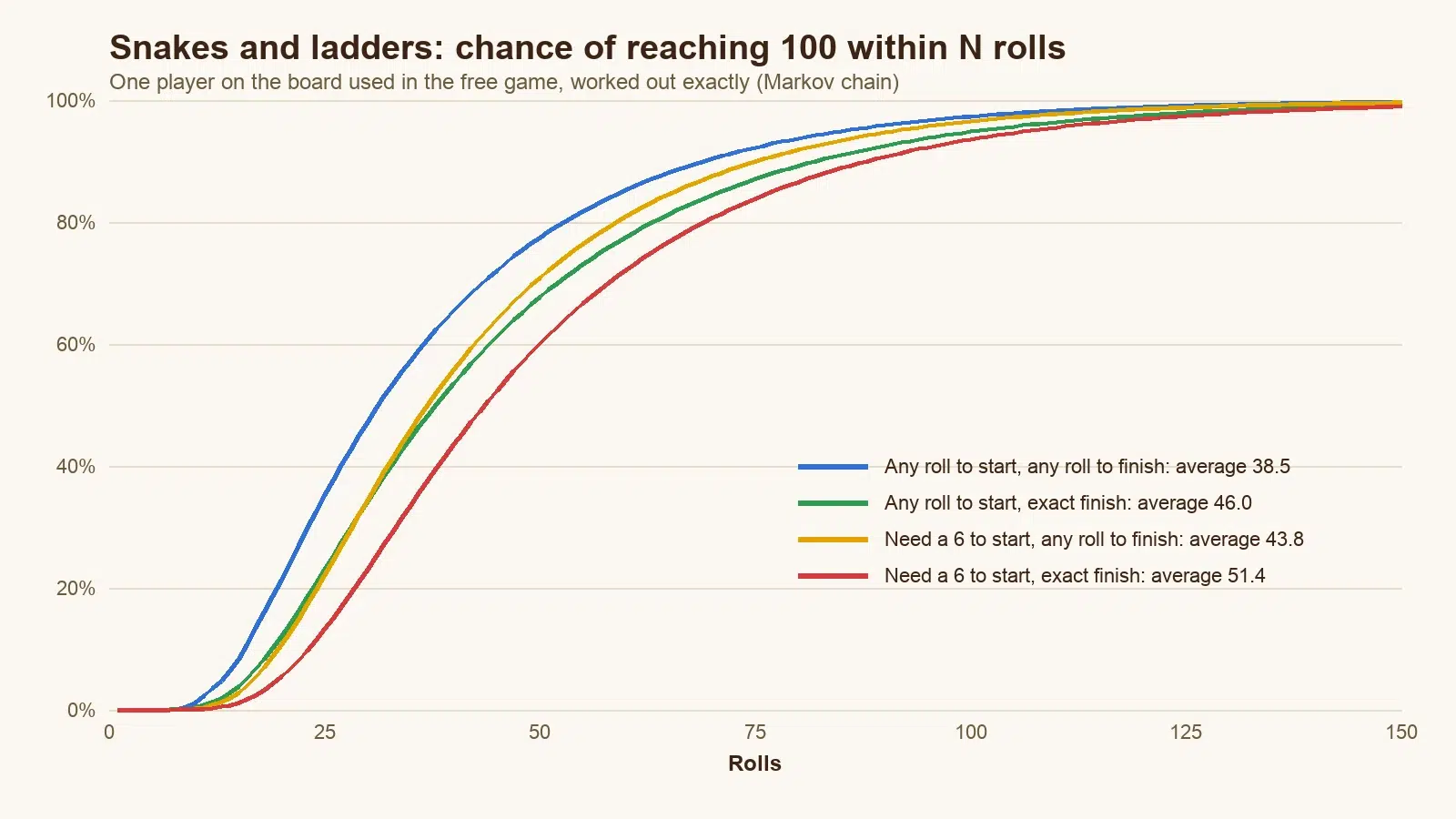
Snakes and ladders is a pure race of luck, which makes it a neat exercise in probability: every square has fixed chances of leading to every other, so the length of a game can be worked out exactly (mathematicians call it a Markov chain). The figures below are for one player on the board in the free game. The method reproduces the published results for the classic 1943 Chutes and Ladders board: 35.8 spins on average, or 39.2 if you must land exactly on 100.
| Rules | Average rolls | Fewest possible | Half of games done by roll | 9 in 10 done by roll | Done within 20 rolls |
|---|---|---|---|---|---|
| Any roll to start, any roll to finish | 38.5 | 7 | 32 | 70 | 21% |
| Any roll to start, exact finish | 46.0 | 7 | 38 | 83 | 12% |
| Need a 6 to start, any roll to finish | 43.8 | 8 | 37 | 76 | 11% |
| Need a 6 to start, exact finish | 51.4 | 8 | 44 | 89 | 5% |
| Name | Language or tradition | Notes |
|---|---|---|
| Moksha Patam | Sanskrit | The “liberation lesson”: the old name of the game |
| Saanp Seedhi, Saanp aur Seedhi, Mokshapat | Hindi | Snake and ladder |
| Parama Padam | Tamil | Played by devotees of Vishnu to stay awake through the night of Vaikuntha Ekadashi |
| Vaikunthapali, Paramapada Sopana Patamu | Telugu | The ladder to salvation |
| Gyan Chauper (Jnan Chauper) | Jain tradition | The game of wisdom, a version built around karma and moksha |
| Shatranj al-‘urafa | Sufi tradition | A version played in India, Iran and Turkey |
Snakes and ladders began in India as one of a family of dice board games that also gave the world Pachisi. As Moksha Patam it was a lesson about destiny: a player’s climb up the board was a journey through life, helped by virtues (the ladders) and set back by vices (the snakes). One traditional board puts the virtues of faith (12), reliability (51), generosity (57), knowledge (76) and asceticism (78) at the feet of the ladders, and vices such as theft (52), lying (58), rage (84), greed (92), pride (95) and lust (99) at the heads of the snakes.
Families returning from India brought the game to Britain, and the earliest known English edition was registered in October 1892. Victorian makers swapped the Indian virtues and vices for English ones. In 1943 the Milton Bradley Company in the United States published it as Chutes and Ladders, with playground chutes instead of snakes. The game even gave English a phrase: being sent “back to square one”.
The other great family race game: Ludo. Learn the rules and play free online.
Ready for a longer game? Try Business: buy cities, build hotels and collect rent. Rules, a free banker and a rules PDF.

After going through several successful experiences with several industry pioneers, Fadi Hayek has managed to excel in the world of content for online gaming by providing unique content for several projects that allowed him to obtain the necessary experience to launch his career. Last but not least, Fadi also holds several certificates, including but not limited to content marketing and iGaming.


