Pachisi
Play Pachisi free in your browser with a computer partner and learn every rule: cowrie throws, graces, castles, captures, plus Chaupar and Chausar.


Play Pachisi free in your browser with a computer partner and learn every rule: cowrie throws, graces, castles, captures, plus Chaupar and Chausar.
Pachisi is the classic race game of India. Four players in two teams race four pieces each out of the centre of a cross-shaped cloth board, all the way round the edge and back home again, moving by throws of six cowrie shells. Land on an opponent and you send them back to the start. The name comes from pachis, the Hindi for twenty-five, the highest throw of the shells, and the game is also called Twenty-Five.
Its older relative Chaupar (also Chausar, Chaupad, Chopad or Pagade) uses the same board with three long dice, and Parcheesi and Ludo are both simplified versions of it. Play Pachisi free below with a computer partner against two computer players, then read the rules step by step, what every throw of the cowries is worth, how Chaupar differs, the odds and some tips.
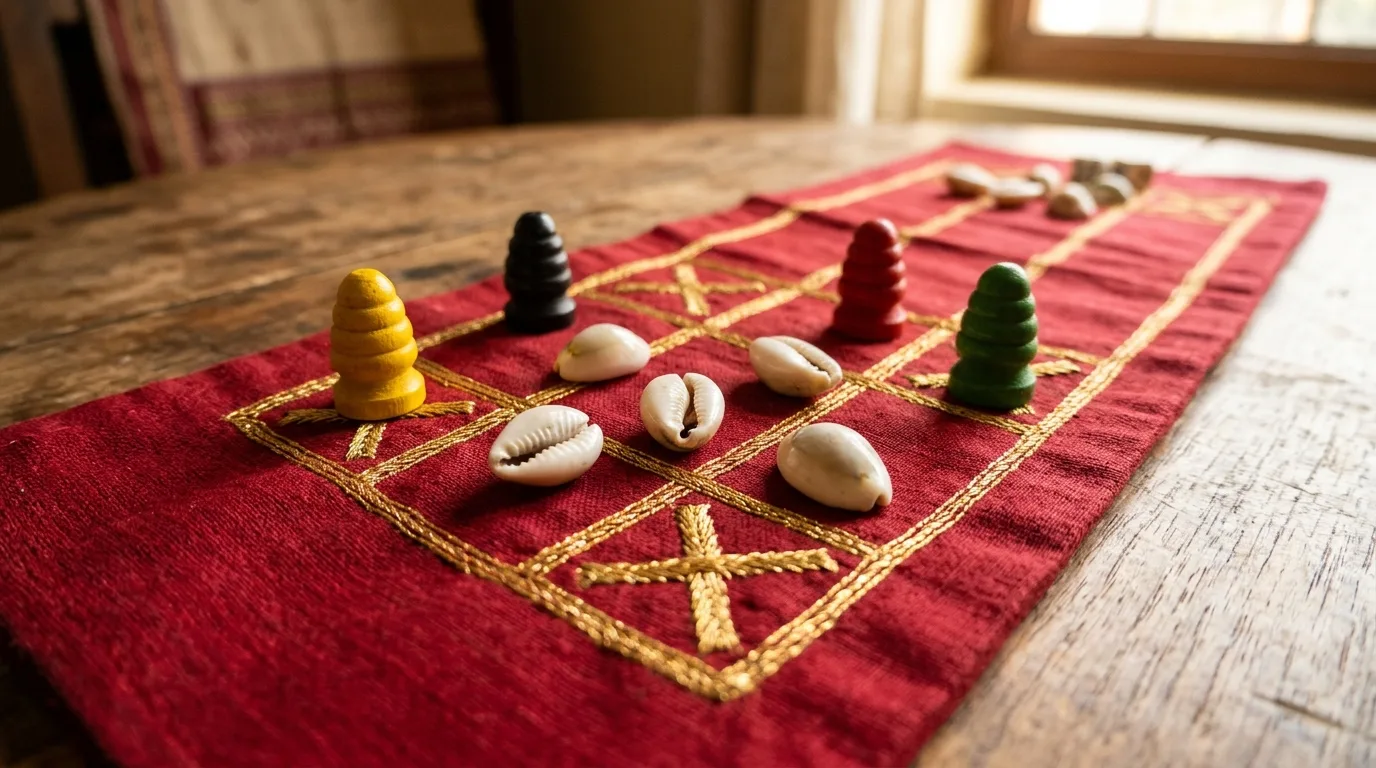
You are yellow at the bottom of the board and your partner Across plays black; Right (red) and Left (green) are the other team. Press Throw to throw the six cowries: a 6, 10 or 25 lets you throw again, so you may end up with several throws. Tap a throw, then the piece to move with it (the button shows where it will land). The table shows how many pieces each player still has waiting in the charkoni, on the board and home. Choose Quick game for two pieces each instead of four.
The free game uses the plainest of the traditional rule sets: six cowries; 6, 10 and 25 are graces that let you throw again; your first piece may leave the charkoni on any throw and every later one, including pieces sent back, only on a grace; a piece leaving the charkoni moves the full throw; nobody may land on a castle an opponent holds; a capture earns another throw; you may skip the rest of your throws; and a piece needs an exact throw to get home, except that a piece on the square next to home finishes on any grace, as no throw is worth 1. A player with every piece home drops out, and a team wins when both partners are home. The Quick game, with two pieces each, is a shortcut for a faster game rather than a traditional rule. The starting player moves one seat round with each new game.
| Pachisi | |
|---|---|
| Other names | Twenty-Five; its close relative is Chaupar (Chausar, Chaupad, Chopad, Pagade in Kannada) |
| Players | 2 to 4, usually four in two teams; partners sit opposite |
| Teams | Yellow and black against red and green |
| Board | A cross of four arms, each three columns of eight squares, round a big centre square, the charkoni; usually embroidered on cloth |
| Pieces | 4 beehive-shaped pieces per player |
| Thrown with | 6 cowrie shells (sometimes 5 or 7) |
| Throws | 2 to 6 mouths up count as they fall; 1 mouth up = 10; none up = 25 |
| Graces | 6, 10 and 25: throw again, and bring a new piece out |
| Safe squares | 12 castles, marked with a cross |
| Aim | Your team wins when both partners have every piece back in the charkoni |
The board is a cross. Each of the four arms has three columns of eight squares, and the big square in the middle, the charkoni, is where every piece starts and finishes. Each player sits in front of one arm. Your pieces come out down the middle column of your own arm, travel anticlockwise right round the outside columns of all four arms, and come back up your middle column into the charkoni: 84 steps in all. Nobody else ever uses your middle column, except to pass over its end square.
Twelve squares are marked with a cross: the end square of each middle column and the fourth square in from the end of each outer column. These are the castles. A piece on a castle cannot be captured, and you may not land on a castle that holds an opponent’s piece, though you can move past it. Four of the castles are exactly 25 steps from home: for you it is the end of the arm on your left (square 59 below), the place to wait for a throw of 25 that takes a piece straight home.
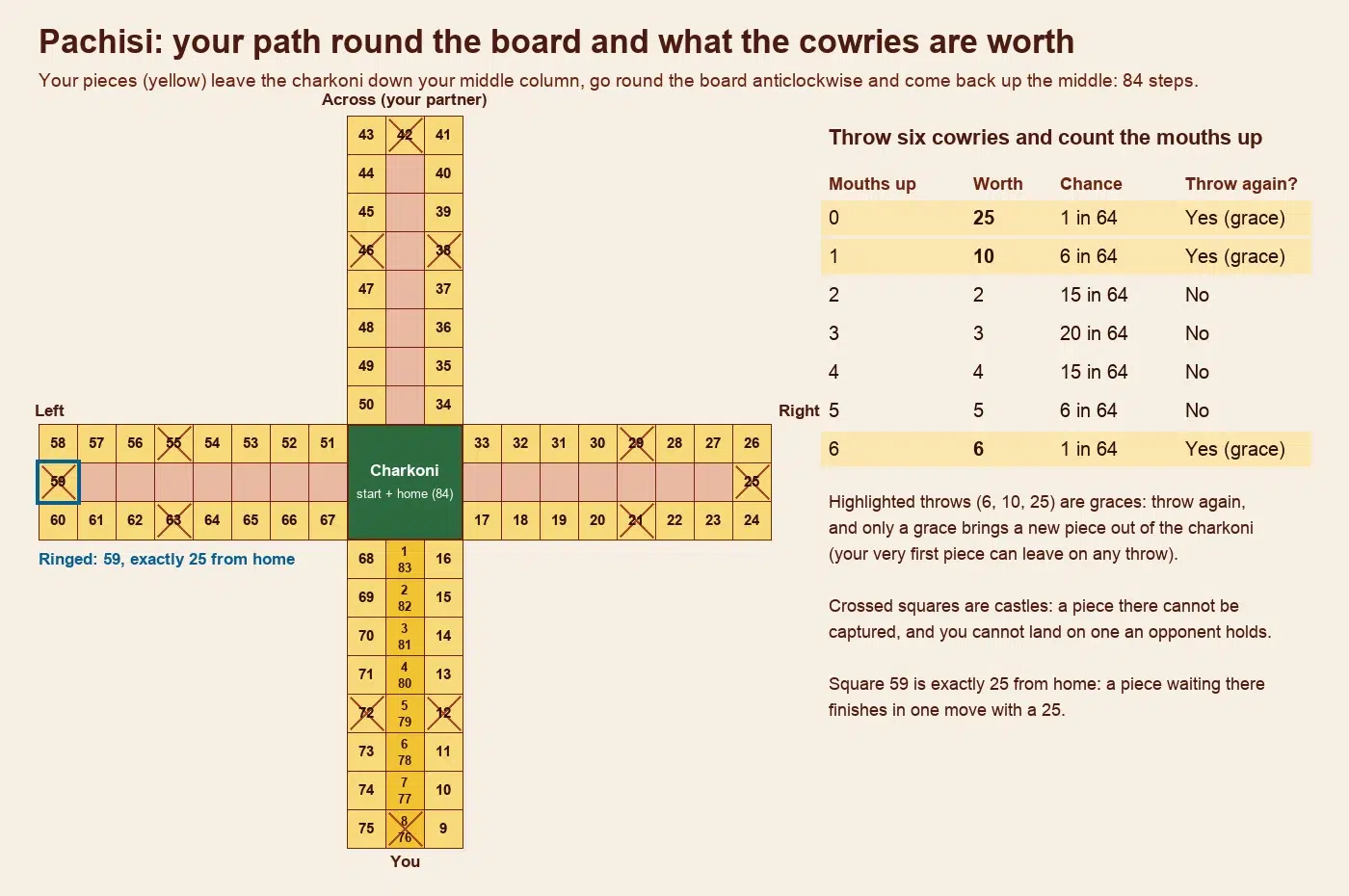
Throw the six cowries from your hand and count how many land with their opening (the “mouth”) facing up. Two to six mouths up count as they fall, but one mouth up is worth 10 and none up is worth 25. With a fair shell landing either way half the time, these are the chances:
| Mouths up | Worth | Chance | Throw again? |
|---|---|---|---|
| 0 | 25 | 1 in 64 (1.6%) | Yes: a grace |
| 1 | 10 | 6 in 64 (9.4%) | Yes: a grace |
| 2 | 2 | 15 in 64 (23.4%) | No |
| 3 | 3 | 20 in 64 (31.2%) | No |
| 4 | 4 | 15 in 64 (23.4%) | No |
| 5 | 5 | 6 in 64 (9.4%) | No |
| 6 | 6 | 1 in 64 (1.6%) | Yes: a grace |
Some families play with seven cowries. In one common version none up is 7, one up 10, two to four up count as they fall, five up is 25, six up 35 and all seven up 14, and every one of 7, 10, 25, 35 and 14 earns another throw. Other versions count six up as 30, and older descriptions use five cowries, where all five mouths up is the 25 that gives the game its name.
| Mouths up (7 cowries) | Worth | Chance |
|---|---|---|
| 0 | 7 | 1 in 128 |
| 1 | 10 | 7 in 128 |
| 2 | 2 | 21 in 128 |
| 3 | 3 | 35 in 128 |
| 4 | 4 | 35 in 128 |
| 5 | 25 | 21 in 128 |
| 6 | 35 (or 30) | 7 in 128 |
| 7 | 14 | 1 in 128 |
Two people can play by taking two colours each: one plays yellow and black, the other red and green, and the game runs exactly as with four players.
There is no single official rule book, and each region and family has its own habits. The most common changes:
Chaupar (also written Chaupad, Chopad or Chopat, called Pagade in Kannada) and Chausar are played on the same cross-shaped board, and the oldest descriptions say they used three long dice instead of cowries: four-sided stick dice, usually marked 1, 2, 5 and 6 (sometimes 1, 3, 4 and 6). Pachisi has been called the poor man’s chaupar, because cowrie shells cost almost nothing. The name chaupar comes from chau, four, and par, cloth, for the four cloth arms of the board; chausar means four roads, a crossroads.
A typical set of long-dice rules:
Chaupar is also widely played with seven cowries. In that version none up is 7, one up 10, five up 25, six up 30 and all seven up 14; a piece enters only on a high throw of 10, 25 or 30, and each high throw brings another throw, but three high throws in a row “burn” (beli jaye) and the turn is lost. Before any piece can go home you must make a tohd, a capture; finishing without one is a bay-thoree, the most embarrassing way to lose. Once all four pieces are in, every high throw adds a bonus step, the peghedu, and the flower squares (eight of them) are safe.
With three long dice marked 1, 2, 5 and 6, every total from 3 to 18 can come up, and the average is 10.5. The most likely totals are 8, 9, 12 and 13 (9 in 64 each); 3, 6, 15 and 18 are the rarest at 1 in 64:
| Total | Chance | Total | Chance |
|---|---|---|---|
| 3 | 1 in 64 | 11 | 3 in 64 |
| 4 | 3 in 64 | 12 | 9 in 64 |
| 5 | 3 in 64 | 13 | 9 in 64 |
| 6 | 1 in 64 | 14 | 3 in 64 |
| 7 | 3 in 64 | 15 | 1 in 64 |
| 8 | 9 in 64 | 16 | 3 in 64 |
| 9 | 9 in 64 | 17 | 3 in 64 |
| 10 | 3 in 64 | 18 | 1 in 64 |
| Pachisi | Chaupar | Parcheesi | Ludo | |
|---|---|---|---|---|
| How you move | Six (or five or seven) cowrie shells | Three long dice, or seven cowries | Two dice | One die |
| To bring a piece out | A grace: 6, 10 or 25 (your first piece on any throw) | Pieces start on the board; with cowries, a 10, 25 or 30 | A 5 | Usually a 6 |
| Teams | Two teams of partners | Two teams of partners | 2 to 4 players | 2 to 4 players |
| Safe squares | 12 castles | Castles ignored with long dice; 8 flower squares with cowries | Safety spaces in the same places as the castles | Varies |
| Extra throws | 6, 10, 25, and usually a capture | None with long dice; high throws with cowries | Doubles, once all four pawns are out | Usually a 6 |
All four are cross-and-circle race games: take every piece round the board and home while sending the other side back. Parcheesi kept the Indian board almost square for square, but swapped the cowries for two cubic dice and dropped the partnerships. Ashta Chamma (Chowka Bara) is the compact South Indian cousin on a 5×5 board.
| Question | Answer |
|---|---|
| Chance that a throw is a grace (6, 10 or 25) | 8 in 64, or 1 in 8 |
| Average value of one throw | 4.23 squares |
| Average throws in a turn (graces bring more) | 1.14, worth about 4.84 squares in all |
| Most likely throws | 2, 3 and 4: together 50 of every 64 throws |
| Chance of a 25 on one throw | 1 in 64 |
| Waiting on the castle 25 from home | A 25 turns up in about 1 turn in 57 (a 6 or 10 keeps your turn going), so it can be a long wait |
| How long is a game? | About 400 throws and 86 turns per player with four pieces each, and around 190 throws in the two-piece Quick game |
| How many captures? | About 7.4 a game with four pieces each, 2.4 with two |
| Does the starting team have an advantage? | Hardly: the team that threw first won 50.3% of 10,000 computer games |
The cross-shaped board is old, but its history is hard to pin down. A board identical to pachisi was found in the Ellora caves, and the dice game of the Mahabharata is often linked with it, although the historian Irving Finkel notes that the epic’s descriptions do not really fit the game. The first clear descriptions come from the 16th century, when chaupar was a favourite gambling game at the court of the Mughal emperor Akbar. At Fatehpur Sikri he had a giant board laid out in the palace courtyard, and he and his courtiers played on it with sixteen young slaves, dressed in the players’ colours, as the pieces.
Cowrie shells were cheap enough to serve as small change for the very poor into the 20th century, which is how pachisi became the everyday version of the game. Westerners took it home too: in 1867 John Hamilton claimed a copyright on “Patcheesi”, renamed it Parcheesi in 1869 and played it with two cubic dice; in 1938 Transogram sold it in the United States as the Game of India. The same family includes Barjis in Syria, Parchís in Spain and Morocco, Sorry! and Ludo.
Chaupar has its own legends: Raja Rasalu wins Raja Sirkap’s kingdom over a game of it, and one king was said to keep two trained mice, Sundari and Mundari, that moved the pieces while he distracted his opponent with stories.
Another board game from India: the Tiger and Goat Game (Aadu Puli Attam, Puli Meka, Bagh Chal), where a few tigers hunt a herd of goats. Rules, strategy and a free game against the computer.
From the same family of Indian dice games: Snakes and Ladders, which began as Moksha Patam. Play it free online with your own house rules.
The modern descendant of Pachisi: Ludo. Read the full Ludo rules and play it free against the computer.
From the same Indian games cupboard: Business, the property-trading board game; read the rules and use the free banker.

After going through several successful experiences with several industry pioneers, Fadi Hayek has managed to excel in the world of content for online gaming by providing unique content for several projects that allowed him to obtain the necessary experience to launch his career. Last but not least, Fadi also holds several certificates, including but not limited to content marketing and iGaming.


