Business Game Rules
How to play the Business board game, square by square, for both common rule sets, with a free online banker and a printable rules PDF.


How to play the Business board game, square by square, for both common rule sets, with a free online banker and a printable rules PDF.
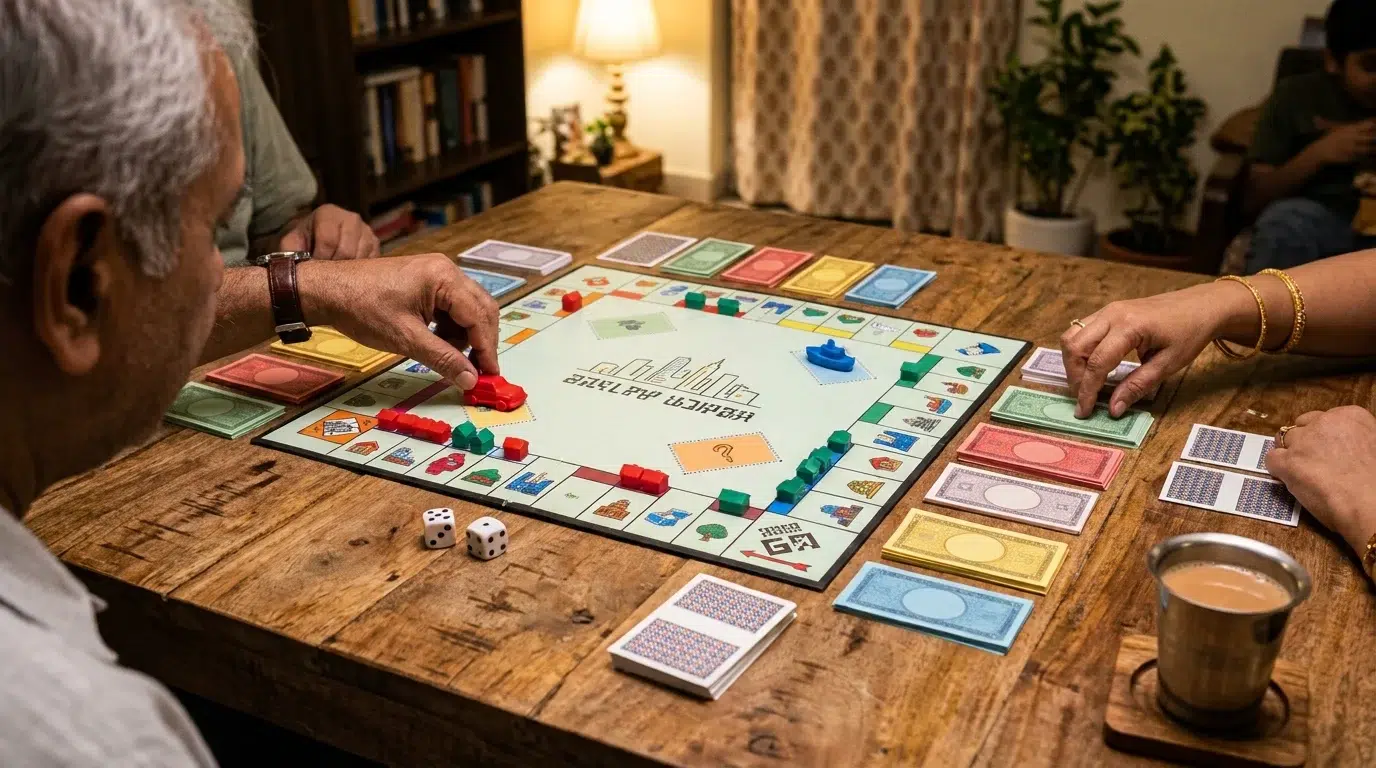
Business is the property-trading board game that fills Indian living rooms on holidays: throw the dice, travel round the board, buy cities, collect rent and try to stay out of jail until everyone else is bankrupt. It is sold under names like Business, International Business and Business India, and it works like the better-known Monopoly.
The trouble is that every edition prints slightly different rules, and the rule sheet is the first thing to go missing. This page sets out the two rule sets most families use, square by square, gives you a free printable rules PDF, and has a free online banker that keeps everyone’s money so you can play without the paper notes.
Play on your own board and let this keep the money. Choose the rule set and the number of players, type your names, then tap a player and the square they landed on. Taxes, the Club House, the Rest House, jail and the Start money are worked out for you under the rules you picked. For rent, buying a city or building, type the amount and press Pay. Keep each player’s number of sites up to date with + and −, because the International Business taxes depend on it. Everything is saved in your browser, and Undo takes back a mistake.
Prefer paper? Download the free Business game rules PDF: a two-page printable summary of both rule sets below.
| International Business rule book | Common Indian house rules | |
|---|---|---|
| Players | 2 to 4, plus a banker | 2 to 4 is ideal, plus a banker |
| Money at the start | $25,000 each, plus a $10,000 credit card | ₹15,000 each |
| Who starts | Highest total on the dice | Highest total, or the first player to throw a 12 |
| Passing Start | +$1,500 | +₹1,500 |
| Income tax | $100 for each site you own, up to $1,000 | ₹200 |
| Asset tax / Wealth tax | $50 for each site you own, up to $500 | ₹200 |
| Club House | Collect $200 from every other player | Pay ₹100 to the bank |
| Rest House | Pay $200 to every other player | Miss your next turn |
| Jail / Prison | Pay $500 or throw a 12 | Pay ₹200 or throw a double within three throws |
| Colour group | Rent doubled on unbuilt sites | Rent doubled |
| How you win | Be the last player left, or the richest when an agreed time is up | Not written into the usual house rules: agree it before you start |
The left column comes from the rule manual printed for one International Business set (a dollar game played on world cities). The right column is the set of house rules most often written down for the Indian rupee editions, which play on Indian cities. If your box has its own rule book, use its numbers: the banker above lets you type any amount.
The International Business set this page follows contains a board, 4 coloured pegs, 2 dice, 35 apartments and hotels, 21 site and property cards in colour groups, 11 Chance and 11 Commonwealth cards, 4 passports, 4 credit cards and 80 notes of $50, $100, $500, $1,000, $5,000 and $10,000. Indian editions use rupee notes and usually call the second card pile Community Chest. Each city card shows its price, its rent with and without buildings, the cost of building and its mortgage value. On one card, for example, Tokyo costs $4,000 and rents for $350 as a bare site, $2,000 with one apartment, $5,000 with three and $6,100 with a hotel.
You collect 1,500 from the bank each time you reach or pass it. The International Business manual adds one strict rule: if you forget to ask for rent, a bonus or a reward before the next throw of the dice, you lose that money.
Each city belongs to a colour group. Own all three sites of a colour and the rent is doubled on the sites you have not built on. Rent with buildings is printed on the card and rises steeply: on the Tokyo card it goes from $350 to $6,100.
Take the top card, do what it says (collect a refund, pay a fine, go to jail) and put it at the bottom of the pile. In International Business the second pile is called Commonwealth, and one of its cards can take away your passport.
In International Business income tax is $100 for every site you own, never more than $1,000, and asset tax is $50 a site, never more than $500. A player with no sites pays nothing. Under the usual Indian house rules both income tax and wealth tax are a flat ₹200.
This is where the two rule sets disagree most. In International Business the Club House pays you: every other player gives you $200. Under the Indian house rules you pay ₹100 to the bank for using the club.
In International Business you pay $200 to every other player. Under the Indian house rules you rest instead: you miss your next turn. If everybody lands in the Rest House in the same round, nobody rests and play goes on.
In International Business you go to prison if you land on it, if a card sends you there, or if you fail to pay a $2,000 credit card instalment. You come out by paying $500 or by throwing a 12. Under the Indian house rules, landing on jail in normal play is only a visit; you are sent there by a card or by throwing doubles three times in a row. To get out, pay a ₹200 fine (and you then collect nothing for passing Start on that turn) or throw a double within three throws, otherwise you miss a turn. You cannot buy property while you are in jail.
Buildings are what make the game. In International Business you can start building once you own two sites of a colour group. Build evenly: you cannot put a second apartment on any site until every site of that colour you own has one. A site holds at most three apartments, and a hotel needs three apartments on each site of the complete three-site group; only one hotel goes on a site. Apartments and hotels cost the amount printed on the card. If the bank runs short of buildings, the last ones are auctioned to the highest bidder.
The Indian house rules let you build once you own the whole colour group (some families allow it with three cards of a colour), also evenly across the group. If the bank has run out of houses, you wait until someone sells theirs back.
Short of cash, you can mortgage a site to the bank for the mortgage value printed on its card. You collect no rent on a mortgaged site, and you get it back by repaying the mortgage value. Only bare sites can be mortgaged: sell any apartments or hotels back to the bank at half price first. In the Indian house rules you can also sell a city to the bank or to another player, and you may only have one property bought on a bank loan at a time.
Two extras make International Business different. Each player gets a credit card worth up to $10,000, usable once in the game to buy a site or pay a penalty. You then pay the bank $2,000 each of the next six times you pass Start: $12,000 in all, so the loan costs you $2,000. Miss an instalment and you go to prison. Each player also has a passport. Lose it to a Commonwealth card and you cannot collect rent until you buy it back for $5,000 or complete six rounds. The banker above handles the credit card for you: it adds the money and takes the instalments at Start.
A player who owes more than they can pay, even after selling and mortgaging, is bankrupt and retires; the bank auctions their properties. The last player left wins. Games can run for hours, so the manual offers a short game: agree a finishing time, deal two city cards to each player (who pays the printed price for them), and play as usual. When time is up, add up your cash, the cost of your properties and buildings, and your mortgaged properties. The highest total wins.
| Event | Chance |
|---|---|
| Throwing a 12 (double six) | 1 in 36 throws |
| Throwing any double | 1 in 6 throws |
| Doubles three times in a row (jail in the house rules) | 1 in 216 |
| Getting out of jail with a double within three throws | 42.1% |
| Most likely total | 7 (1 in 6 throws) |
| No 12 after 10 throws | 75.4% |
| No 12 after 20 throws | 56.9% |
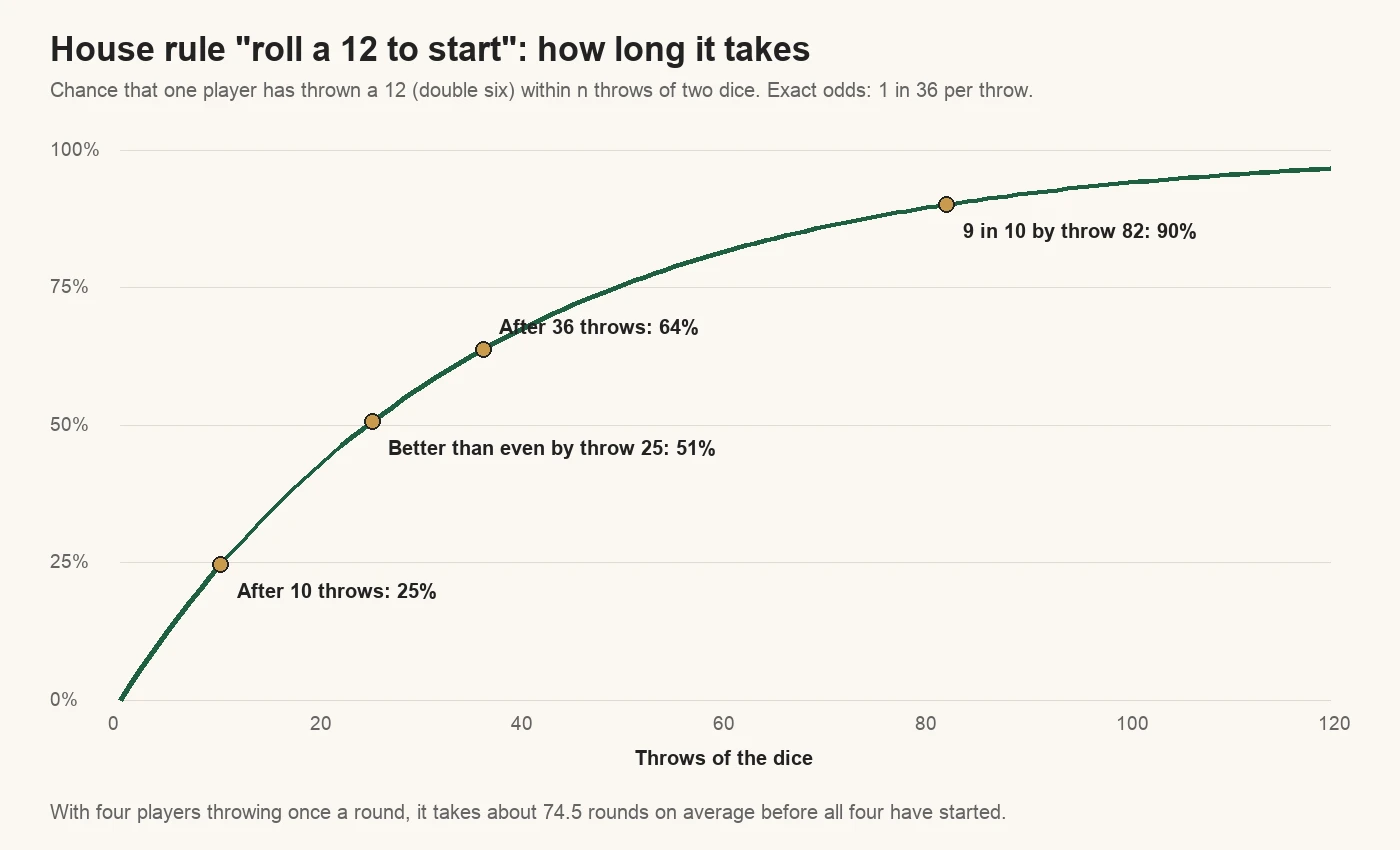
Think twice before playing “roll a 12 to start”. A 12 comes up once in 36 throws, so a player needs 25 throws to have a better-than-even chance of starting and 82 for a 9 in 10 chance. With four players throwing once a round, only 10.7% of first rounds see anyone start at all, and it takes about 74.5 rounds on average before all four are moving. The same rule decides the International Business jail escape, which is why paying $500 is usually quicker.
Business is usually described as the Indian version of Monopoly, and the core is the same: a loop of properties in colour groups, a bonus for passing the start square, card piles, taxes, a jail, houses and hotels, mortgages and bankruptcy. What changes is the board (Indian or world cities instead of streets), the money, and squares like the Club House and Rest House. If you like dice games with money at stake, try Ludo and Snakes and Ladders for the race games, or Carrom for something with more skill.

After going through several successful experiences with several industry pioneers, Fadi Hayek has managed to excel in the world of content for online gaming by providing unique content for several projects that allowed him to obtain the necessary experience to launch his career. Last but not least, Fadi also holds several certificates, including but not limited to content marketing and iGaming.


