Ashta Chamma
Play Ashta Chamma (Chowka Bara, Thaayam) free in your browser against three computer players and learn every rule: cowry throws, hitting, the inner ring and how to win.


Play Ashta Chamma (Chowka Bara, Thaayam) free in your browser against three computer players and learn every rule: cowry throws, hitting, the inner ring and how to win.
Ashta Chamma is the traditional race game of South India, played on a 5×5 board with four pawns each and four cowry shells instead of dice. You throw the shells, count how many land mouth-up, and move a pawn round the outside of the board, then round the inner ring and into the centre. Land on an opponent and you send them back to the start. It is known as Chowka Bara or Chauka Bara in Karnataka, Daayam or Thaayam in Tamil Nadu and Challas Aath in Maharashtra.
It belongs to the same family as Parcheesi and is often called a forerunner of Ludo. Play Ashta Chamma free below against three computer players, then read the rules step by step, what each throw of the shells is worth, the doubles rule, the names in every language and some tips.
You are red and start on the crossed square at the bottom of the board; Right (blue), Across (green) and Left (yellow) are computer players. Press Throw to throw the four cowries. A 4 or an 8 lets you throw again, so you can end up with several throws to spend. Tap a throw, then tap one of your lit pawns to move it that many squares. The table shows how many pawns each player has home and on the start square, and whether their inner ring is open yet.
In the free game every pawn starts on its crossed start square, each shell lands mouth-up half the time, turns go You, Right, Across, Left, and landing on a square holding opponent pawns sends all of them back. Two of your own pawns may share a square, but the doubles rule below is not used. The starting player moves one seat round with each new game.
| Ashta Chamma | |
|---|---|
| Other names | Chowka Bara, Chauka Bara, Katte Mane (Kannada); Daayam, Thaayam (Tamil); Kavidi Kali, Pakidakali (Malayalam); Challas Aath (Marathi); Chomal Ishto (Gujarati) |
| Players | 2 to 4 |
| Board | 5×5 squares, usually drawn in chalk; the middle square of each side and the centre are crossed (safe) |
| Pieces | 4 pawns per player |
| “Dice” | 4 cowry shells (or tamarind seeds, or a die) |
| Throws | 1, 2 or 3 mouths up; all 4 up = chamma (4); none up = ashta (8) |
| Path | Round the outside anticlockwise, round the inner ring clockwise, into the centre |
| Aim | Be first to bring all four pawns to the centre |
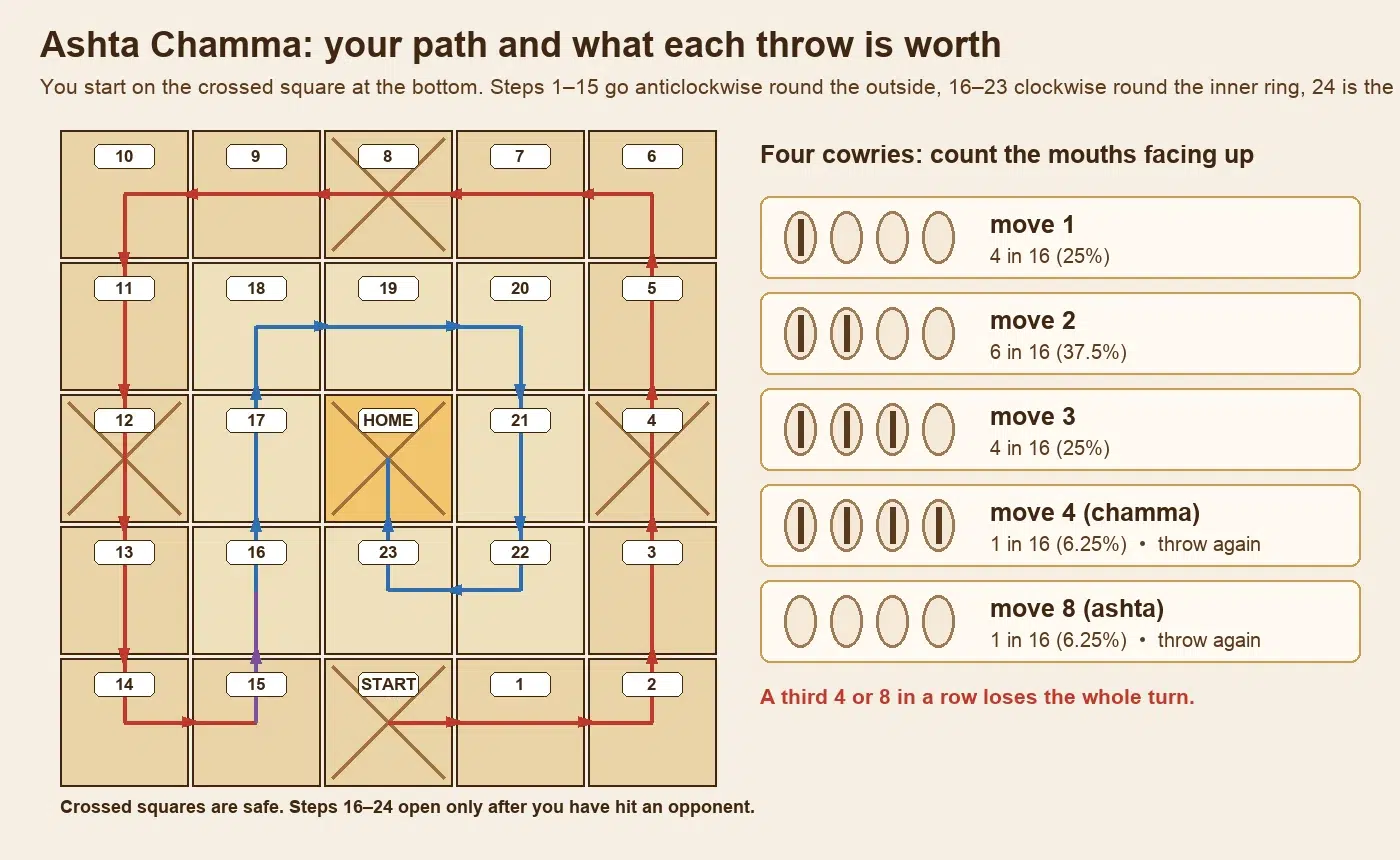
Draw a square of 5×5 squares on the floor or on paper. Mark an X in the middle square of each of the four sides and in the centre square. The four side crosses are the players’ starting squares, and all five crossed squares are safe.
Two to four people play, each with four pawns of their own colour. Each player sits on one side and their pawns start on the crossed square in the middle of that side.
Throw the four shells and count how many land with the mouth (the toothed slit) facing up:
| Shells mouth-up | Name | Move | Chance (fair shells) |
|---|---|---|---|
| 1 | 1 square | 4 in 16 (25%) | |
| 2 | 2 squares | 6 in 16 (37.5%) | |
| 3 | 3 squares | 4 in 16 (25%) | |
| All 4 | Chamma | 4 squares, throw again | 1 in 16 (6.25%) |
| None | Ashta | 8 squares, throw again | 1 in 16 (6.25%) |
A 4 or an 8 gives you another throw, and you keep throwing until you get a 1, 2 or 3. Only then do you move. If you throw a 4 or 8 three times in a row, you lose the whole turn and none of those throws can be used.
Each throw moves one pawn that many squares along your path. If you have several throws you can split them: after a 4 and then a 3 you can move one pawn 4 squares and another 3, or the same pawn 7. Your pawns go anticlockwise round the outer squares until they reach the square just before their starting square.
If your pawn lands on a square holding an opponent’s pawn, you hit it: it goes back to its starting square and has to go round again. Hitting also earns you an extra throw. Pawns on a crossed square are safe and cannot be hit, and pawns of different players can share it.
From the last outer square a pawn turns into the inner ring and goes round it clockwise. But you may only enter the inner ring once you have hit at least one opponent’s pawn. The condition is on the player, not the pawn: one hit opens the inner ring for all four of your pawns. Until then, if no pawn can move, you lose that turn.
After the inner ring a pawn moves into the centre square, which is home. It needs the exact number: a pawn 3 squares from the centre cannot use a 4. The first player to bring all four pawns home wins.
Many players also use the double: two of your own pawns on the same square.
The same game goes by many names; these are the ones in use in each region:
| Language or region | Names |
|---|---|
| Telugu (Andhra Pradesh, Telangana) | Ashta Chamma (అష్టా చమ్మ) |
| Kannada (Karnataka) | Chauka Bara (Chowka Bara), Gatta Bara, Katte Mane, Gatta Mane, Chakaara |
| Tamil (Tamil Nadu) | Daayam, Thaayam |
| Malayalam (Kerala) | Pakidakali, Kavidi Kali |
| Marathi (Maharashtra) | Challas Aath, Champool, Kach Kangri, Champal Paani |
| Hindi (Madhya Pradesh) | Atthu, Kanna Kauri, Chunga, Cheeta, Chanda |
| Gujarati (Gujarat) | Chomal Ishto, Ahmedabad Baji, Kaangi Chaala, Mach Kooki |
| Rajasthan | Changa Po |
| Chhattisgarh | Teri Chowk |
| West Bengal | Ashta Kashte (on a 7×7 board) |
Worked out exactly for fair shells, and from 10,000 four-player games between the free game’s computer players:
| Question | Answer |
|---|---|
| Most common throw | 2, with 6 chances in 16 (37.5%) |
| Chance of a 4 or an 8 (throw again) | 1 in 8 (12.5%) |
| Chance of losing a turn to three 4s or 8s in a row | 1 in 512 (about 0.2%) |
| Average distance per turn of throws | 2.82 squares (a 4 or 8 averages 6 and adds another throw) |
| Does the first player have an advantage? | A small one: 25.8% of wins for the first player against 23.7% for the fourth |
| How long is a game? | About 270 throws in a four-player game, with around 48 hits |
| Ashta Chamma | Pachisi | Ludo | |
|---|---|---|---|
| Board | 5×5 squares, path spirals to the centre | Cross-shaped track | Cross-shaped track |
| Thrown with | 4 cowries | 6 or 7 cowries | One die |
| Pawns | 4 each | 4 each | 4 each |
| Special rule | Inner ring opens only after you hit someone | Throws of 10, 25 and 6 bring extra throws | A 6 brings a pawn out and another throw |
All three are race games in the same family: move all your pawns round a track and home, sending opponents back on the way. Ashta Chamma is the compact one, drawn in chalk in a minute on any floor.
Ashta Chamma is one of the old board games of India, most popular in the South, and was traditionally drawn on the floor with chalk and played with cowry shells or tamarind seeds. Its Telugu name comes from its two best throws: ashta (every shell mouth-down, worth 8) and chamma (every shell mouth-up, worth 4). The game plays a part in the 2006 film Vanaja, and in 2008 a Telugu comedy film took its name. Today it is encouraged for children, who learn to count and plan their moves while they wait for their turn.
The bigger cousin: Pachisi (and Chaupar) on the cross-shaped cloth board, with six cowries, graces and castles. Free to play online with a computer partner.
Also from South India: Aadu Puli Attam / Puli Meka, the tiger and goat game. Play it free as the tigers or the goats.

After going through several successful experiences with several industry pioneers, Fadi Hayek has managed to excel in the world of content for online gaming by providing unique content for several projects that allowed him to obtain the necessary experience to launch his career. Last but not least, Fadi also holds several certificates, including but not limited to content marketing and iGaming.


