Nine Men's Morris
Play nine men's morris free against the computer and learn every rule: placing your men, making mills, moving, flying, and how to win.


Play nine men's morris free against the computer and learn every rule: placing your men, making mills, moving, flying, and how to win.
Nine men’s morris is a two-player strategy game that is at least as old as the Roman Empire. Each player has nine men and a board of 24 points made of three squares, one inside the other. Get three of your men in a row along a line, a mill, and you take one of your opponent’s men off the board. Bring your opponent down to two men, or leave them with no move, and you win.
The game is also called mill, merels or merrills, nine-man morris and, in North America, cowboy checkers. It is quick to learn and surprisingly deep: computers have shown that with perfect play on both sides it ends in a draw. Play it free below against the computer, then read the rules step by step, the points players argue about, and how to win.
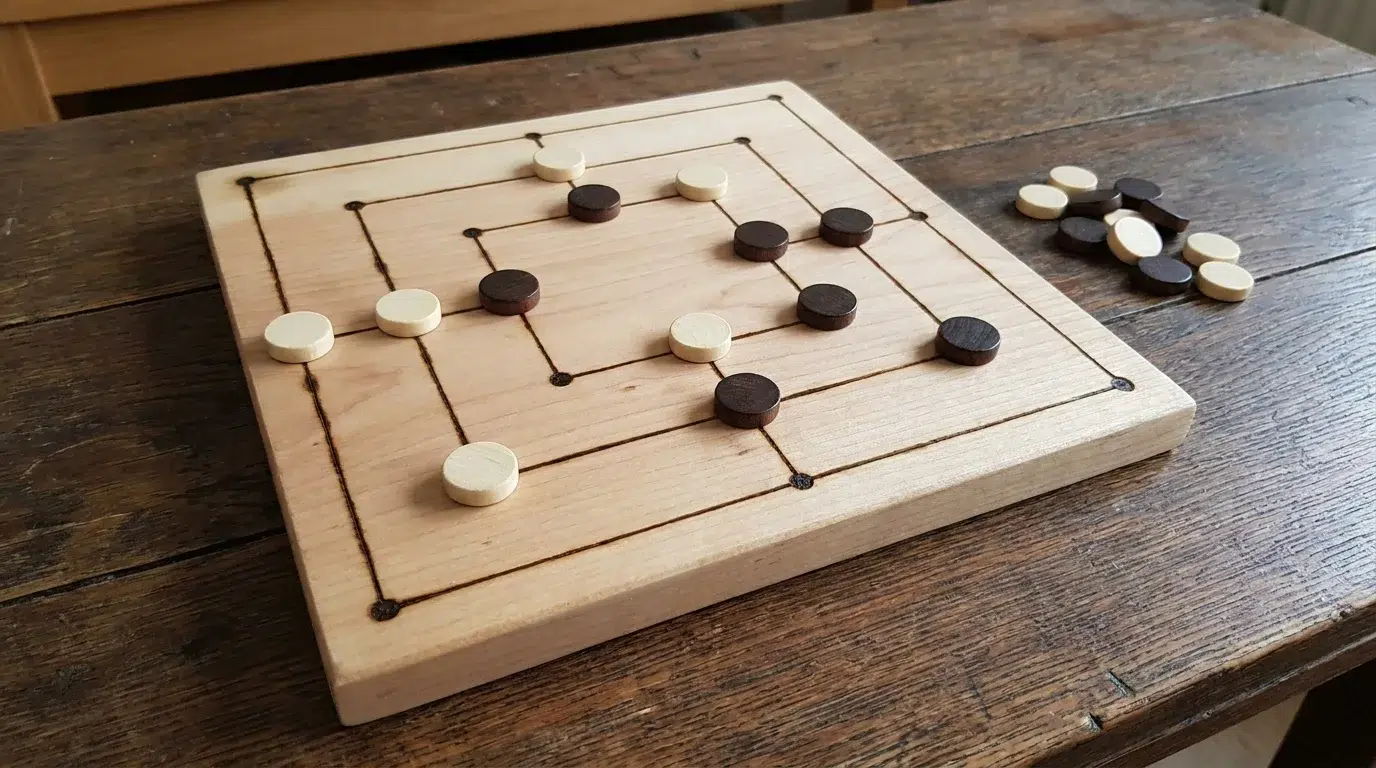
You play against the computer and swap colours every game; White always moves first. While you still have men to place, tap any empty point to put one there. Once all eighteen men are on the board, tap one of yours and then a lit point next to it to move it along a line. When you make a mill, the computer’s men you are allowed to take start flashing: tap one. Choose Easy or Hard, and turn flying on or off.
The free game follows the standard rules below, with flying when a player is down to three men (switch it off for the no-flying game). Points are named by column a to g and row 1 to 7, as in the board diagram further down. To stop a game going round in circles, it is a draw when the same position comes up for the third time or after 50 moves each with no man taken.
| Nine men’s morris | |
|---|---|
| Other names | Mill, mills, the mill game, merels, merrills, nine-man morris, ninepenny marl, cowboy checkers |
| Players | 2 |
| Men | 9 each, usually white and black |
| Board | 24 points on three squares, one inside another, joined at the middle of each side |
| Mill | Three of your men in a row along one line: take one of your opponent’s men |
| Phases | Placing, then moving, then (often) flying when a player is down to three men |
| You win when | Your opponent is down to two men or cannot move |
| Game length | 5 to 60 minutes |
| Luck | None: it is pure strategy |
| Solved? | Yes. With perfect play it is a draw (Ralph Gasser, 1996) |
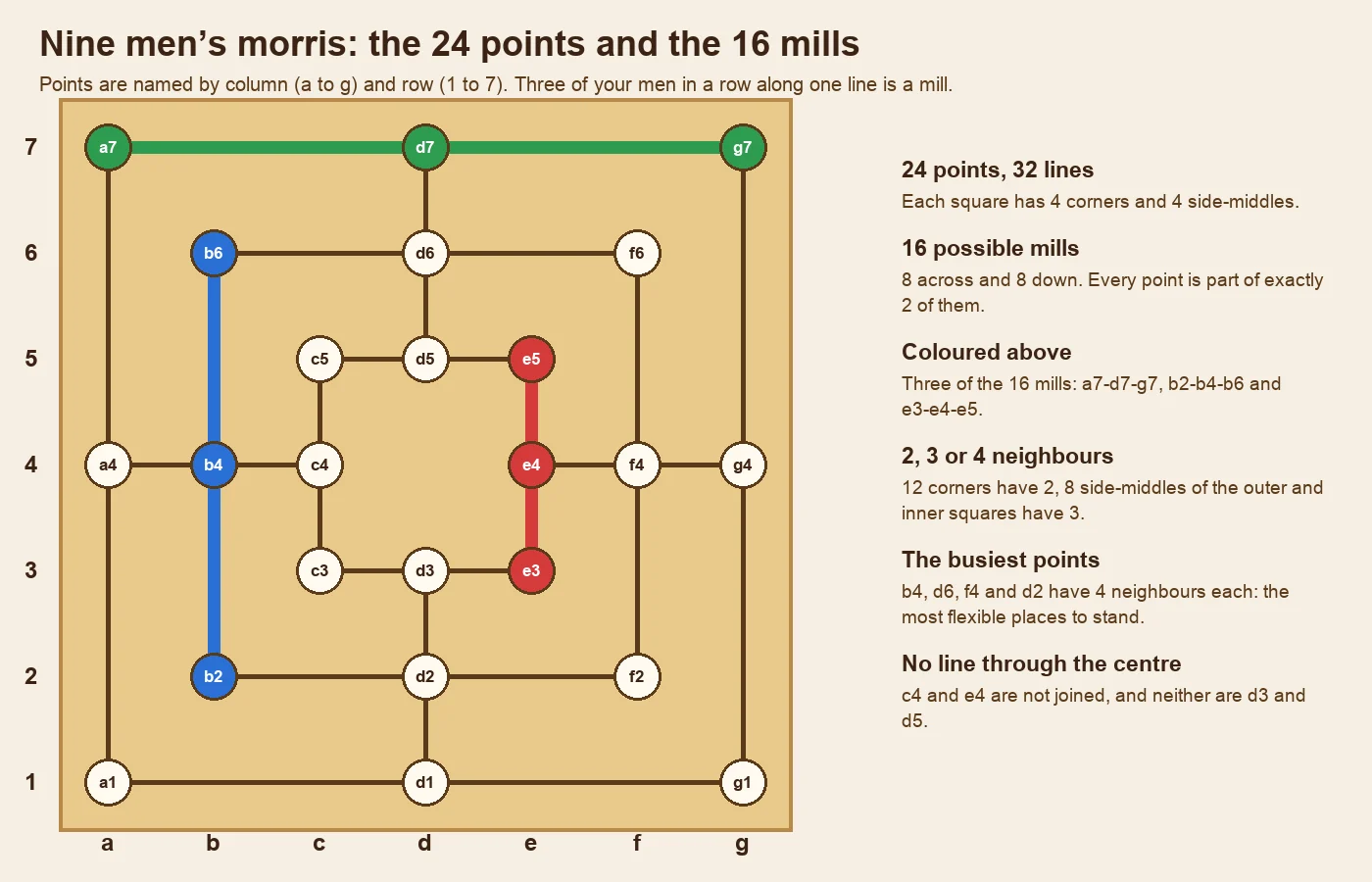
The board is three squares, one inside the other, joined by four short lines at the middle of each side. Men stand on the 24 points where lines meet or turn: the four corners and four side-middles of each square. There are 32 lines between neighbouring points and 16 possible mills, eight across and eight down, and every point is part of exactly two of them. There is nothing in the middle of the board: the inner square’s sides are not joined across the centre, so no mill passes through it.
Points are not equal. The twelve corners have only 2 neighbours, the side-middles of the outer and inner squares have 3, and the four side-middles of the middle square (b4, d6, f4 and d2) have 4. Those four crossing points are the most flexible places to stand, which is why good players fight for them early.
Most rule books agree on everything above except flying. Some say it is the way the game is played, some treat it as a variation, and some never mention it. Flying was brought in to give the weaker side a chance when it is one man away from losing; without it, a player with three men keeps moving along the lines like everyone else.
| Question | Usual answer |
|---|---|
| I made two mills with one move. Do I take two men? | No. Most rules, including the ones used to solve the game, allow one man per turn however many mills you close. |
| All my opponent’s men are in mills. Can I take one? | Yes. If every man is in a mill, you may take any of them. |
| Can I make the same mill again? | Yes. Move a man out of the mill and back on a later turn, and you take another man every time. |
| Is flying allowed? | Usually yes, once a player is down to three men. Agree before you start: some families and many older books play without it. |
| What if a player cannot move? | That player loses, even with plenty of men left. |
| Can the game be a draw? | Yes. Players usually agree a draw when the same position keeps coming back. The rules used to solve the game make a repeated position a draw. |
| Can I capture during the placing phase? | Yes. A mill made while placing takes a man just like a mill made by moving. |
| Question | Answer |
|---|---|
| Is the game solved? | Yes. In 1996 Ralph Gasser showed that the starting position is a draw with perfect play on both sides, using endgame databases of about 10 billion positions and a search through all 18 placements. |
| How many positions are there? | Each of the 24 points can be empty, white or black, so there are at most 324, about 280 billion, ways to fill the board. Gasser’s count of the positions that matter for the moving phase was 7,673,759,269. |
| How many mills can be made? | 16: eight across and eight down. Every point is on two of them. |
| Which points are the strongest? | b4, d6, f4 and d2, with 4 neighbours each. Twelve corners have only 2. |
| Who moves first in the moving phase? | White: Black places the eighteenth man, so White makes the first move. |
| Easy vs Hard | In 400 games between the two levels of the free game, Hard won 92%. |
| Hard vs Hard | In 200 games between two Hard computers, 12% were draws; a game lasted about 33 turns each and 8.3 men were taken. |
| When is the first mill? | In those games the first mill came, on average, on turn 12 (counting both players’ turns), still in the placing phase. |
| Does White have an advantage? | A small one. Of the 177 decided Hard-vs-Hard games, White won 104 (59%) and Black 73. |
| How do games end? | Mostly with a player down to two men. Only 16% of decided Hard-vs-Hard games ended with a player blocked in (18% without flying). |
| Game | Men each | Board | What is different |
|---|---|---|---|
| Three men’s morris | 3 | 3 by 3 points, like noughts and crosses | Place your three men, then move them; the first to make a line of three wins. In the Philippines it is played as Tapatan, on a board with diagonals. |
| Six men’s morris | 6 | The two inner squares only | No flying. Popular in medieval Italy, France and England, it had died out by about 1600. |
| Nine men’s morris | 9 | 3 squares, 24 points | The standard game on this page. |
| Lusalos (Philippines) | 9 | Same as nine men’s morris | The same rules without flying. Choose “Flying: Off” in the free game to play it. |
| Lasker morris | 10 | Same as nine men’s morris | Invented by the chess world champion Emanuel Lasker: you may move a man on the board instead of placing a new one, from the start. |
| Twelve men’s morris | 12 | Nine men’s board plus four diagonals | With 24 men for 24 points the board can fill up while placing, which is a draw. Played in South Africa as Morabaraba. |
Boards cut into the roofing slabs of the temple at Kurna in Egypt have been dated to around 1400 BCE, but the historian Friedrich Berger argued that some of them show Coptic crosses and “certainly they cannot be dated”. The game was probably well known to the Romans, whose buildings carry many boards, and the poet Ovid may describe a morris game in his Ars Amatoria (about 8 CE).
It was at its most popular in medieval England. Giant boards were cut into village greens, and in A Midsummer Night’s Dream Shakespeare’s Titania complains that “the nine men’s morris is filled up with mud”. A 13th-century book of games, the Libro de los juegos, even shows it played with dice. The word morris has nothing to do with morris dancing: it probably comes from the Latin merellus, a counter or gaming piece.
Another strategy game with no luck: the Tiger and Goat Game, 3 tigers against 15 goats (or 4 against 20 in Bagh Chal). Free to play against the computer.
Another pure-logic puzzle: how to play Sudoku, with the solving techniques and a free Sudoku game with hints.

After going through several successful experiences with several industry pioneers, Fadi Hayek has managed to excel in the world of content for online gaming by providing unique content for several projects that allowed him to obtain the necessary experience to launch his career. Last but not least, Fadi also holds several certificates, including but not limited to content marketing and iGaming.


