How to Play Chess
Sixteen pieces each and one goal, checkmate: the full rules of chess, how to set up the board, how every piece moves, and a free game to play.


Sixteen pieces each and one goal, checkmate: the full rules of chess, how to set up the board, how every piece moves, and a free game to play.
Chess is a strategy game for two players on a board of 64 squares. Each side starts with 16 pieces: a king, a queen, two rooks, two bishops, two knights and eight pawns. White moves first, the players then take turns, and the aim is to checkmate the opponent’s king: attack it so that it has no way to escape. There are no dice and no hidden cards, so every game is decided by the moves alone. This guide explains how to play chess under the official FIDE Laws of Chess: how to set up the board, how each piece moves, check and checkmate, the three special moves (castling, en passant and promotion), how a game can end in a draw, what each piece is worth, and how to read chess notation. You can also play a full game against the computer right here.
Play a full game of chess against the computer below, free and with no sign-up. Tap one of your pieces to see every square it can legally move to, then tap the square you want. Castling, en passant and promotion all work exactly as described in this guide, and the game ends by itself on checkmate, stalemate or a draw.
Choose to play White (you move first) or Black, and Easy or Hard. Stuck? Hint shows the move the Hard computer would play, and Undo takes your last move back. Every move is written in the move list in standard notation, which is explained further down.
| Chess | |
|---|---|
| Players | Two: White and Black. |
| Board | 8×8, 64 squares in alternating light and dark colours. The columns are called files (a to h) and the rows ranks (1 to 8). |
| Pieces | 16 each: 1 king, 1 queen, 2 rooks, 2 bishops, 2 knights and 8 pawns. |
| First move | White always moves first. The players then move one piece per turn. |
| Captures | Move onto a square occupied by an opponent’s piece to capture it and take it off the board. You can never capture your own pieces. |
| Goal | Checkmate: attack the opponent’s king so that no move can get it out of attack. |
| Special moves | Castling, en passant and pawn promotion. |
| Draws | Stalemate, agreement, a dead position, threefold repetition and the fifty-move rule. |
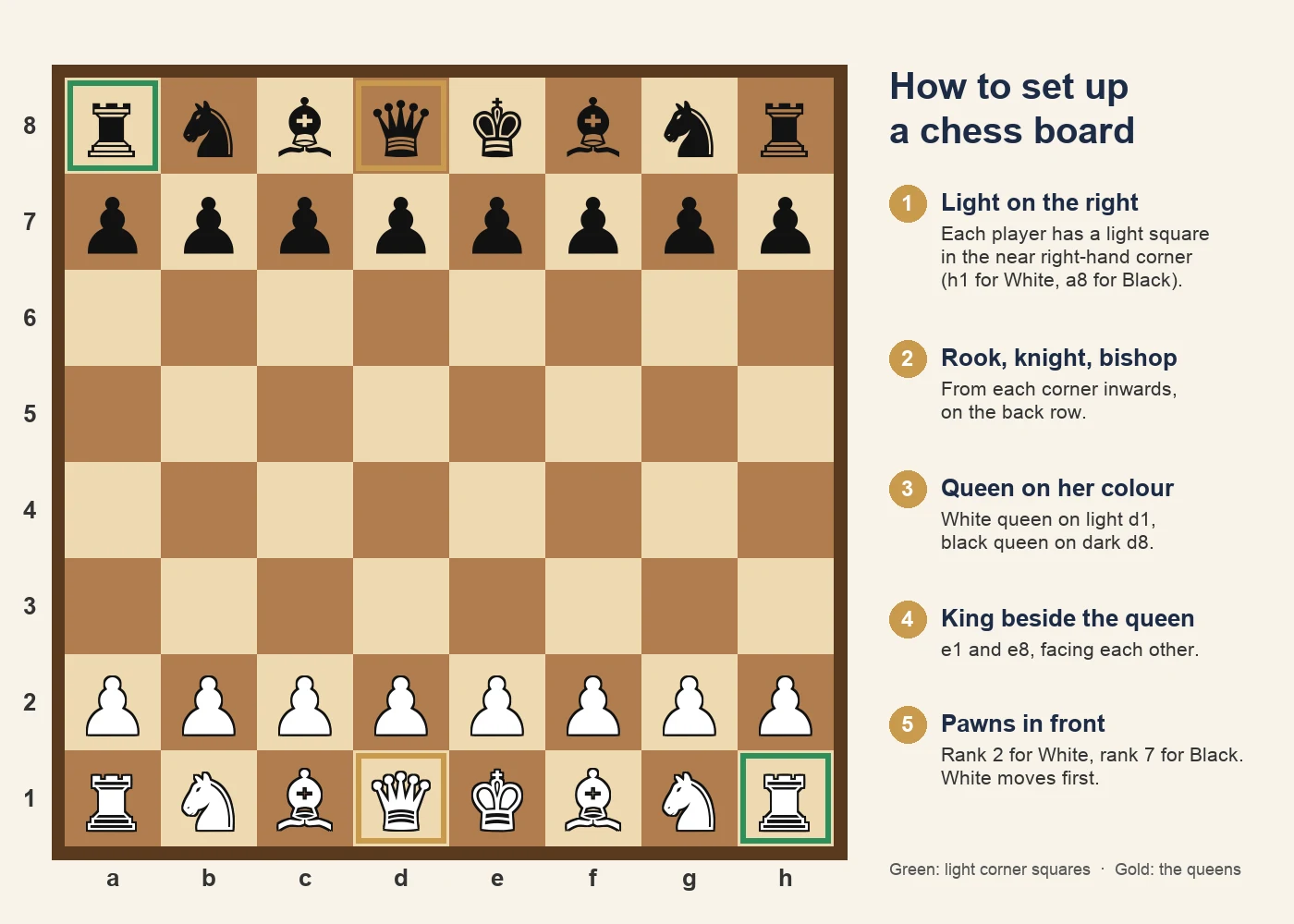
Done correctly, the two armies mirror each other exactly: queen facing queen and king facing king. The most common set-up mistakes are a board turned the wrong way, which puts a dark square in your right-hand corner, and swapping the king and queen. Every starting square, the common mistakes and a free set-up trainer are on the chess board setup page.
All pieces except the knight move in straight lines and cannot jump over other pieces. A piece captures by moving onto an opponent’s square, the same way it moves, except for the pawn. The last column shows how many squares each piece can reach from d4, near the centre of an empty board, which is a good measure of how mobile it is. For every piece’s name, history and reach from any square, see chess pieces names and moves.
| Piece | Each side has | How it moves | From d4 |
|---|---|---|---|
| King (K) | 1 | One square in any direction. It can never move onto a square where it would be attacked. | 8 |
| Queen (Q) | 1 | Any number of squares in a straight line: along a rank, a file or a diagonal. | 27 |
| Rook (R) | 2 | Any number of squares along a rank or a file. | 14 |
| Bishop (B) | 2 | Any number of squares along a diagonal, so it stays on its starting colour all game. | 13 |
| Knight (N) | 2 | In an L shape: two squares in one direction, then one square to the side. The only piece that can jump over others. | 8 |
| Pawn | 8 | One square straight forward, or two squares forward on its first move, if the squares are empty. It captures one square diagonally forward. Pawns never move backwards. | 1 or 2 forward |
At the start of the game only the pawns and the knights can move, so White has exactly 20 possible first moves: 16 pawn moves (each of the eight pawns one or two squares) and 4 knight moves.
Castling is the only move in which you move two pieces at once. The king moves two squares towards one of its rooks, and that rook jumps over to the square the king has just crossed. Castling on the king’s side (the short side) is written O-O; on the queen’s side (the long side) it is O-O-O. After White castles short, the king stands on g1 and the rook on f1; after castling long, the king is on c1 and the rook on d1.
You can castle only if all of these are true:
To castle over the board, move the king first, with one hand, then the rook. Under the touch-move rule, touching the rook first can oblige you to make a rook move instead. For every castling rule, the tricky cases and nine positions to practise, see castling in chess.
En passant (French for “in passing”) is a special pawn capture. When a pawn moves two squares forward from its starting square and lands right beside one of your pawns, your pawn can capture it as if it had moved only one square: your pawn moves diagonally onto the square the other pawn skipped, and the pawn that moved two squares is removed. You must do it on the very next move or the chance is gone.
Example: White has a pawn on e5 and Black plays …d5, moving the d-pawn two squares. White can now play exd6, landing on d6 and taking the pawn on d5. Only pawns can capture en passant, and only pawns can be captured that way. For more examples, the cases where it is not allowed and nine positions to practise, see en passant explained.
A pawn that reaches the far side of the board (rank 8 for White, rank 1 for Black) must be exchanged, as part of the same move, for a queen, rook, bishop or knight of its own colour. It cannot stay a pawn or become a king. You can choose any of the four even if you still have that piece, so a player can have two or more queens. Players choose a queen almost every time; promoting to anything else is called underpromotion, and a knight is the usual choice when it gives check that a queen could not.
| Result | How it happens |
|---|---|
| Win | You checkmate your opponent, your opponent resigns, or your opponent runs out of time on the clock (unless you have no way left to checkmate, which makes it a draw). |
| Draw by stalemate | The player to move has no legal move and is not in check. |
| Draw by agreement | Both players agree to a draw, after each has made at least one move. |
| Draw by dead position | Neither side can checkmate by any series of legal moves, for example king against king, or king and bishop against king. |
| Draw by threefold repetition | The same position, with the same player to move and the same possible moves, appears for the third time. A player claims the draw. |
| Draw by the fifty-move rule | Each player has made 50 moves in a row with no capture and no pawn move. A player claims the draw. |
| Automatic draw | In FIDE events, a position that appears five times, or 75 moves each without a capture or pawn move, ends the game as a draw even if nobody claims it. |
Over the board, threefold repetition and the fifty-move rule are draws that a player has to claim. In the game on this page they end the game automatically, as they do on most chess sites.
To decide whether a trade is good, players count material using a standard points scale. The king has no value because it can never be captured or traded.
| Piece | Value | Example |
|---|---|---|
| Pawn | 1 point | Losing a pawn for nothing is a small but real disadvantage. |
| Knight | 3 points | Equal to a bishop: trading one for the other is even. |
| Bishop | 3 points | Two bishops together are usually worth a little more than a bishop and a knight. |
| Rook | 5 points | Winning a rook for a knight or bishop (“winning the exchange”) gains 2 points. |
| Queen | 9 points | Worth almost two rooks. Losing the queen early is usually decisive. |
These numbers are only a guide. A piece that is active and well placed is worth more than one stuck behind its own pawns, and a material lead does not count for anything if your king is about to be checkmated.
Chess moves are written in algebraic notation. Each square has a name: its file letter (a to h, from White’s left) followed by its rank number (1 to 8, from White’s side). A move is the piece letter followed by the square it moves to.
The shortest possible game shows how it reads. Fool’s mate: 1.f3 e5 2.g4 Qh4#, and White is checkmated after two moves each.
In the game above, Hint is a good way to learn: compare the computer’s suggestion with the move you had in mind and work out why it is better.
The number of possible games explodes after only a few moves. Counting every legal move by either player from the starting position:
| Moves played | Possible games |
|---|---|
| 1 (White) | 20 |
| 2 (one each) | 400 |
| 3 | 8,902 |
| 4 (two each) | 197,281 |
| 5 | 4,865,609 |
These are the standard published counts used to test chess programs, and the game on this page reproduces every one of them exactly.
The rules themselves are old. The modern moves of the queen and the bishop took shape in southern Europe in the late 15th century; the rule that White moves first was settled in the 19th century; and the Staunton design of pieces, introduced in 1849, is the standard set used in tournaments today. The rules of play are now set by FIDE, the International Chess Federation.
For another classic game of pure strategy for two, try checkers or Nine Men’s Morris, both free to play against the computer. Stratego adds hidden pieces, and Chinese checkers is a race for up to six players.

After going through several successful experiences with several industry pioneers, Fadi Hayek has managed to excel in the world of content for online gaming by providing unique content for several projects that allowed him to obtain the necessary experience to launch his career. Last but not least, Fadi also holds several certificates, including but not limited to content marketing and iGaming.


