Chess Pieces: Names and Moves
King, queen, rook, bishop, knight and pawn: how each chess piece moves, what it is worth and where it starts, with a free explorer to try them.


King, queen, rook, bishop, knight and pawn: how each chess piece moves, what it is worth and where it starts, with a free explorer to try them.
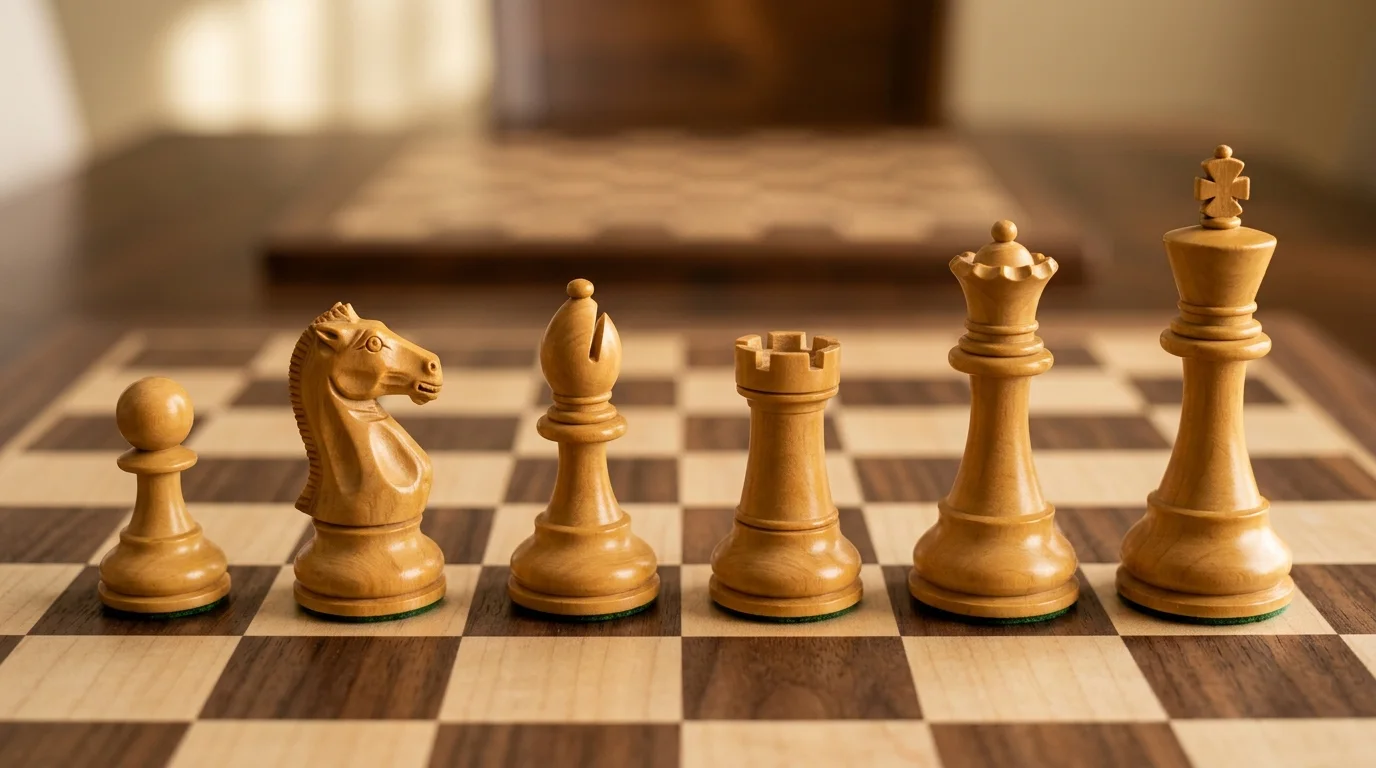
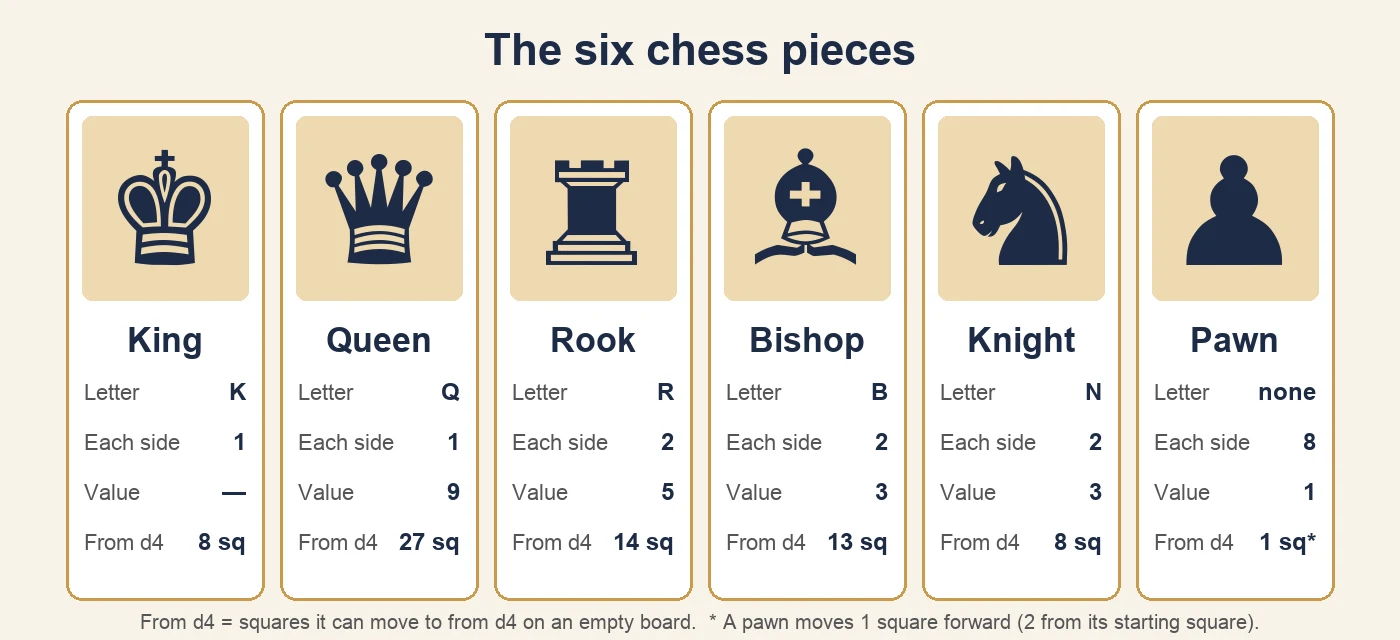
There are six different chess pieces: the king, queen, rook, bishop, knight and pawn. Each player starts with 16 of them: one king, one queen, two rooks, two bishops, two knights and eight pawns, so there are 32 pieces on the board at the start of a game. This page gives the name of every chess piece, how each one moves and captures, what it is worth, where it starts, and where its name comes from. You can also tap any piece onto any square of the free explorer below to see every square it can reach, then test yourself with a 12-question quiz.
For the full rules, including check, checkmate and how a game ends, see how to play chess, where you can also play a free game against the computer.
| Piece | Per side | Letter | Value | White starts on |
|---|---|---|---|---|
| ♚King | 1 | K | Not counted | e1 |
| ♛Queen | 1 | Q | 9 | d1 |
| ♜Rook | 2 | R | 5 | a1, h1 |
| ♝Bishop | 2 | B | 3 | c1, f1 |
| ♞Knight | 2 | N | 3 | b1, g1 |
| ♟Pawn | 8 | None | 1 | a2 to h2 |
Black’s pieces start on the same files on the other side of the board: the back row on rank 8 and the pawns on rank 7. In notation the knight is written N, because K is already taken by the king, and pawns get no letter at all: a pawn move is written with just the square, such as e4.
Pick a piece, then tap any square. Green dots show every square it can move to on an empty board, and for a pawn the red rings show where it would capture. Then switch to the quiz: six questions on the names of the pieces and six on how far they reach.
All the pieces except the knight move in straight lines and cannot jump over other pieces. Every piece except the pawn captures the same way it moves, by landing on the square of an enemy piece and removing it from the board.
The king is the most important piece: if it is trapped and cannot escape capture, that is checkmate and the game is lost. It moves one square in any direction, forwards, backwards, sideways or diagonally, so it reaches 8 squares from the middle of the board and only 3 from a corner. It can never move onto a square that an enemy piece attacks. Once a game, it can also castle together with a rook, moving two squares towards the rook while the rook jumps over to the other side of it. Castling is explained step by step, with a free trainer, in castling in chess.
The king is the tallest piece in the set and wears a crown topped with a small cross, which is the easiest way to tell it apart from the queen.
The queen is the most powerful piece. It moves any number of squares in a straight line: along a rank, along a file or along a diagonal, as long as nothing is in the way. That makes it a rook and a bishop combined. From d4 on an empty board it reaches 27 squares, and even from a corner it reaches 21. The queen is worth 9 points, more than any other piece, which is why a pawn that reaches the far side of the board is almost always promoted to a queen.
Each queen starts on her own colour: the white queen on the light square d1, the black queen on the dark square d8. In the standard set she wears a coronet rather than the king’s cross.
The rook moves any number of squares along a rank or a file, in other words straight up, down or sideways, but never diagonally. On an empty board it always reaches exactly 14 squares, wherever it stands: seven along its rank and seven along its file. Each player starts with two rooks, one in each corner, and the rook is the other piece that takes part in castling. It is worth 5 points.
The rook is shaped like a small castle tower, and many people call it a castle. Chess reference books describe that name as informal and old-fashioned: in chess books and at the board it is always the rook.
The bishop moves any number of squares along a diagonal. Because it only ever moves diagonally, a bishop stays on the same colour of square for the whole game: each player has one bishop that travels on light squares and one on dark squares. From d4 it reaches 13 squares, but only 7 from a corner. White’s bishops start on c1 and f1, Black’s on c8 and f8. A bishop is worth 3 points.
The top of the bishop has a deep slit that represents a bishop’s mitre, the tall hat that gave the piece its English name.
The knight moves in an L shape: two squares in one direction along a rank or file, then one square to the side. It is the only piece that can jump over other pieces, so a crowded board never blocks it. From the centre it can reach 8 squares, but from a corner only 2, which is why players say a knight on the rim is dim. Each time a knight moves it lands on the opposite colour from the one it left. The knights start on b1 and g1 for White and b8 and g8 for Black, between the rooks and the bishops, and each is worth 3 points.
The knight is shaped like a horse’s head, and beginners often call it the horse. In many languages that is its real name.
The pawn is the most numerous and the weakest piece: each player has eight, starting on the second rank. It moves one square straight forward, or two squares forward on its first move, but only into empty squares. Unlike every other piece it captures differently from how it moves: one square diagonally forward. A pawn can never move backwards.
Pawns have two special moves. En passant lets a pawn capture an enemy pawn that has just moved two squares to land beside it. And when a pawn reaches the far side of the board it is promoted: it must be exchanged straight away for a queen, rook, bishop or knight of the same colour. The new piece does not have to be one that was captured, so a player can have two or more queens at once. A pawn is worth 1 point.
To judge whether a trade is good, players count material with a standard points scale. The king is not given a value, because it can never be captured or traded.
| Piece | Points | Equal to |
|---|---|---|
| Pawn | 1 | The basic unit |
| Knight | 3 | About three pawns |
| Bishop | 3 | About three pawns; in open positions two bishops are usually stronger than two knights |
| Rook | 5 | A minor piece and two pawns |
| Queen | 9 | About a rook and a minor piece plus a pawn, or close to two rooks |
The values are a guide, not a rule: a well-placed knight can be worth more than a bishop shut in by its own pawns. For more on using them, see the piece values section of the chess guide.
Strictly, “chess pieces” means all 16 of a player’s men, but players often use the word more narrowly. The major pieces are the queen and the rooks; the minor pieces are the bishops and the knights; the king is in a group of its own. When players talk about “winning a piece” or “sacrificing a piece” they mean a minor piece, a bishop or a knight, and pawns are usually not called pieces at all.
A good way to compare the pieces is to count how many squares each one can move to on an empty board. The table below counts every square on the board for each piece, using the same move rules as the explorer above.
| Piece | From a corner | From the centre (d4) | Average over all 64 squares |
|---|---|---|---|
| Queen | 21 | 27 | 22.8 |
| Rook | 14 | 14 | 14.0 (always 14) |
| Bishop | 7 | 13 | 8.8 |
| King | 3 | 8 | 6.6 |
| Knight | 2 | 8 | 5.2 |
The queen’s numbers are always exactly the rook’s and the bishop’s added together, because she moves like both. The rook is the only piece whose reach never changes. The bishop and the knight lose the most from standing at the edge, which is why both are usually developed towards the centre early in the game.
Chess came to Europe from Persia and the Arab world, where it was called shatranj, and several pieces have changed their names and their moves on the way.
| Piece | Old name | What changed |
|---|---|---|
| King | Shah (Persian for king) | The name is the origin of the words “check” and “checkmate”. |
| Queen | Ferz or vizier, the king’s counsellor | The ferz could move only one square diagonally. It became the queen, and the most powerful piece, much later. Russian players still call it ferz. |
| Rook | Rukh (Persian for chariot) | The English name comes from the Persian word, not from the bird or a castle. |
| Bishop | Alfil (elephant) | The alfil jumped exactly two squares diagonally. The name survives as alfil in Spanish and alfiere in Italian, and Russian still calls it slon, “elephant”. |
| Knight | Horse | In many languages the piece is still called a horse. In German it is the Springer, “jumper”. |
| Pawn | Foot soldier | From the Old French paon, from the Latin for foot soldier. In German it is the Bauer, “farmer”. |
Because the names differ between languages, the letters used in notation do too. The FIDE Laws of Chess let each player use the letters common in their own country: a French player writes F for fou, the bishop, and a Dutch player writes L for loper.
The pieces shown on this page are in the Staunton style, the international standard for tournament chess since 1849. Each piece is easy to recognise by its top: a cross for the king, a coronet for the queen, a battlement for the rook, a slit mitre for the bishop, a horse’s head for the knight and a round ball for the pawn. The king is always the tallest piece and the pawn the smallest.
Once you know the pieces, the next step is the full rules: how to set up the board, check and checkmate, and the special moves. They are all in how to play chess, and the trickiest pawn rule has its own page and trainer at en passant explained. For other board games, try checkers or backgammon.

After going through several successful experiences with several industry pioneers, Fadi Hayek has managed to excel in the world of content for online gaming by providing unique content for several projects that allowed him to obtain the necessary experience to launch his career. Last but not least, Fadi also holds several certificates, including but not limited to content marketing and iGaming.


