Boggle Rules and Free Boggle Solver
Play the three-minute word game free, find every word on your own board, and learn the rules and scoring.


Play the three-minute word game free, find every word on your own board, and learn the rules and scoring.
Boggle is the three-minute word game played with 16 letter dice: shake them into a 4 × 4 grid, then race to find words by joining letters that touch. Play it free below, or type in the letters of your own board and see every word hidden in it. Then read the official rules, how scoring works, and what 100,000 random boards say about how many words a board really holds.
Loading the Boggle board…
The board uses the 16 dice of the current set. Words are checked against ENABLE, a public-domain list of about 170,000 English words that word-game players use widely; Boggle itself accepts any word in a standard English dictionary, so a few proper dictionary words may be missing and a few rare ones included.
| Boggle | |
|---|---|
| Players | 2 or more (the box says ages 8 to adult) |
| Equipment | 16 letter cubes, a 4 × 4 grid with a dome or lid, a 3-minute sand timer, a pencil and paper for each player |
| Goal | List more high-scoring words than anyone else before the timer runs out |
| Words | Three letters or more, spelled through letters that touch, using each cube only once |
| Scoring | Only words nobody else found score: 1 point for 3 or 4 letters, up to 11 for 8 or more |
| Round | 3 minutes |
| Invented by | Allan Turoff; published by Parker Brothers for the 1973 holiday season, now by Hasbro |
The official rule sheet uses a grid that spells OIL, OILS, SILO and SOIL to show legal paths, and two classic mistakes: you cannot use one S twice to write SOILS, and you cannot jump over a letter to reach the next one.
Any word that can be found in a standard English dictionary is allowed: nouns, verbs, adjectives, adverbs, plurals and other forms and tenses of a word. The rule sheet also allows:
The rule sheet does not name one: any word found in a standard English dictionary counts. That leaves room for argument over rare words, so agree on one dictionary before the first round and use it to settle challenges. The game and solver on this page check words against ENABLE, a free public-domain list of about 170,000 English words.
And it rules out a few things:
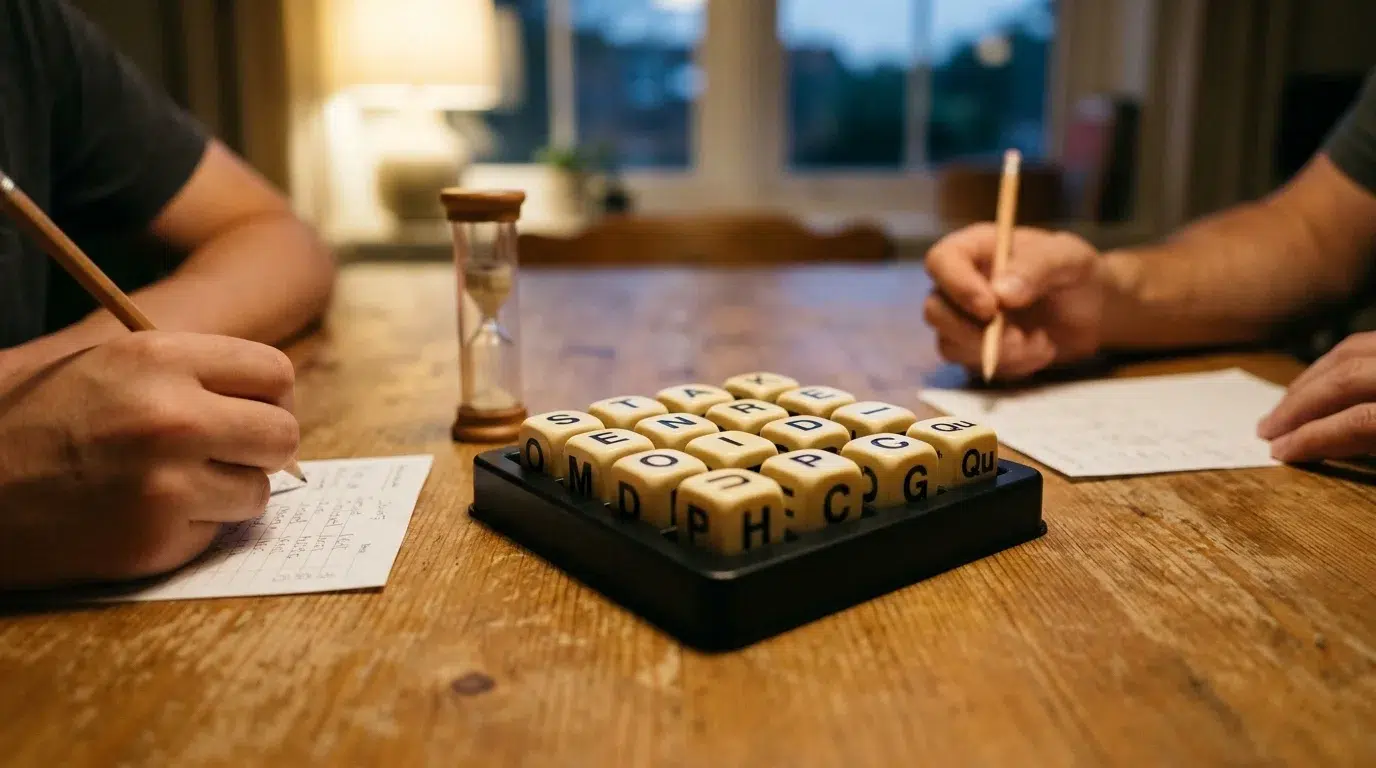
Two cube quirks are worth knowing. One cube shows Qu rather than a lone Q, and it counts as two letters when you score: QUIT is a four-letter word made from three cubes. And because a cube can land any way up, M and W are told apart by their sides (M straight, W slanted), and Z has a line under it so it is not read as N.
After the lists are read and shared words crossed off, each player scores their remaining words by length:
| Letters in the word | Points |
|---|---|
| 3 | 1 |
| 4 | 1 |
| 5 | 2 |
| 6 | 3 |
| 7 | 5 |
| 8 or more | 11 |
Qu counts as two letters, so QUEST scores as a five-letter word. The player with the most points wins the round. You can also play several rounds and stop when someone reaches 50 points, 100 points or any target the table agrees on.
The cancellation rule is what makes Boggle more than a vocabulary test. Common words such as TEN, NOTE or STONE are usually found by several players and score nothing, so the points go to the player who spots the longer or less obvious word that nobody else wrote down.
Three house rules are worth trying once everyone knows the game: a four-letter minimum, so nobody spends the round writing three-letter words; a two-minute timer for a faster game; and a penalty for invalid words, in which a word that is misspelled, made up or not on the board costs the points it would have scored. Agree any of these before the first shake.
| Version | Grid | Main differences |
|---|---|---|
| Boggle | 4 × 4, 16 dice | The standard game: 3 minutes, words of 3 letters or more. |
| Big Boggle | 5 × 5, 25 dice | No three-letter words. The Winning Moves version (2011) adds a die with letter pairs such as Qu, Th and In. |
| Super Big Boggle | 6 × 6, 36 dice | 4-minute timer, words of 4 letters or more, a die with three blank “word stop” faces, and 2 points per letter for words of 9 letters or more. |
| Boggle Reinvention | 4 × 4 | Released in 2008 with the dice sealed in a plastic unit and a built-in timer. |
Some sets also include a red Boggle challenge cube with six harder letters. It replaces one ordinary cube, and any word that uses it earns a bonus.
A Boggle set has 16 dice with 6 letters each, 96 faces in all. The letters have changed over the years: a new set introduced in 1987 replaced the older “classic” set. These are the 16 dice of the newer set, which is the one the game above uses:
| Die | Letters | Die | Letters |
|---|---|---|---|
| 1 | A A E E G N | 9 | D I S T T Y |
| 2 | A B B J O O | 10 | E E G H N W |
| 3 | A C H O P S | 11 | E E I N S U |
| 4 | A F F K P S | 12 | E H R T V W |
| 5 | A O O T T W | 13 | E I O S S T |
| 6 | C I M O T U | 14 | E L R T T Y |
| 7 | D E I L R X | 15 | H I M N Qu U |
| 8 | D E L R V Y | 16 | H L N N R Z |
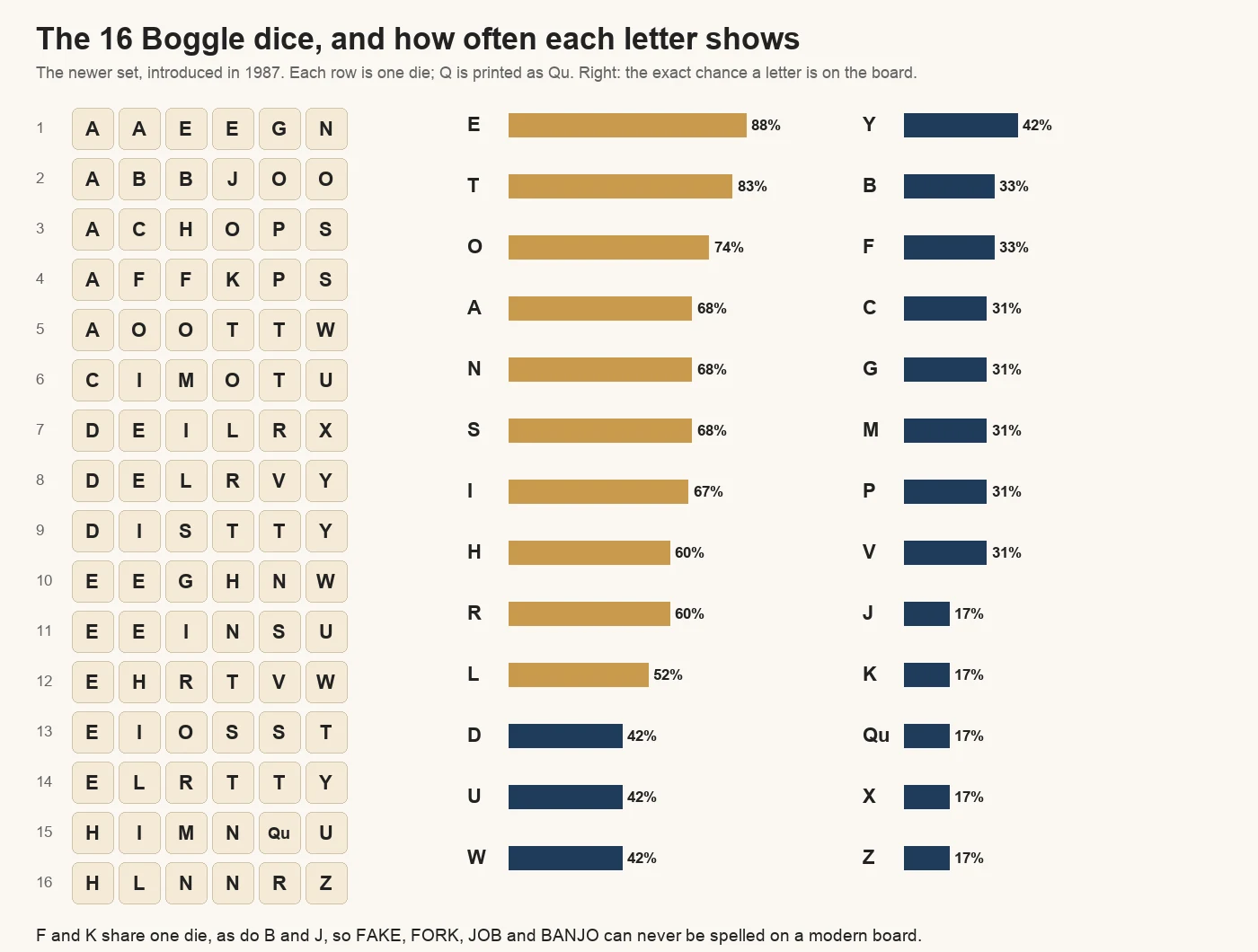
Every die is used in every game, so the chance of seeing a letter can be worked out exactly. E is on 88% of boards and T on 83%, while J, K, Qu, X and Z each sit on a single face of a single die and show up on just 17% of boards, one game in six. A board averages 5.5 vowels (A, E, I, O or U), and only 3.6% of boards have two or fewer.
The dice also hide a quirk. F and K appear only on the same die, and so do B and J. Since a die shows one face at a time, words such as FAKE, FORK, JOB and BANJO can never be spelled on a modern Boggle board.
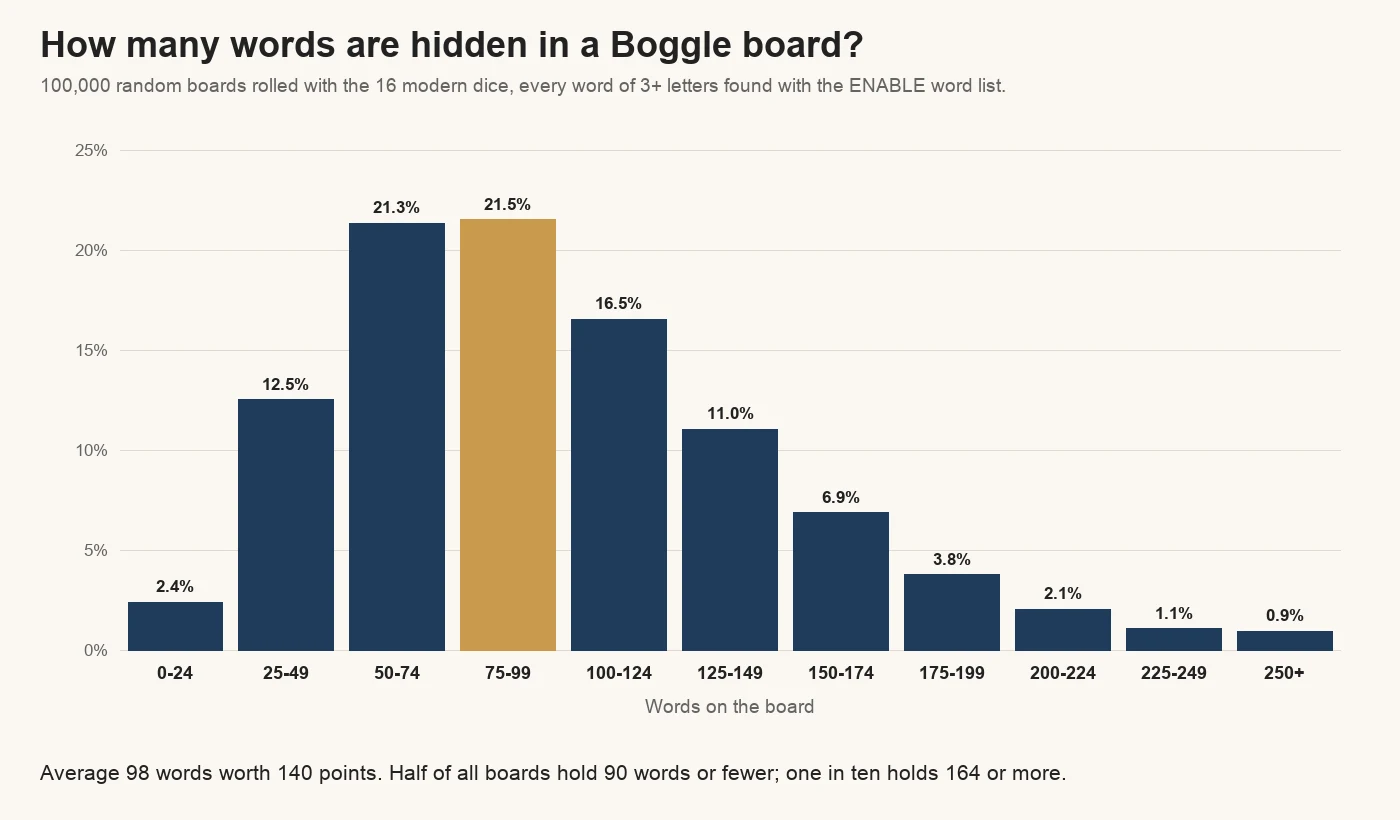
The figures below come from 100,000 random boards rolled with the newer dice, counting every word of three letters or more in the same word list as the game above.
| Over 100,000 random boards | Newer dice (1987 set) | Classic dice |
|---|---|---|
| Average words on the board | 98 | 90 |
| Average total points if you found them all | 140 | 124 |
| Half the boards hold this many words or fewer | 90 | 83 |
| Boards with 100 words or more | 42% | 36% |
| Average longest word | 6.7 letters | 6.5 letters |
| Boards with a word of 8 letters or more | 22% | 17% |
The average board holds about 98 words worth 140 points, but boards vary a lot: one in ten holds 42 words or fewer, and one in ten holds 164 or more. A word of eight letters or more, worth 11 points on its own, is on only 22% of boards, so most rounds are won with four, five and six-letter words. The newer dice produce about 9% more words than the classic set, The redesign cut back on awkward letters: the classic set has two Ks, for example, and the newer set only one.
No real player finds every word. The totals are what is on the board, which is why the solver above is useful after a round: it shows the long words everyone missed.
Using a solver during a round is cheating, just as checking a dictionary during the timer would be. After the round, a solver is a fair way to settle a challenge, check a word that someone has traced on the board, and learn the words you missed. Type the 16 letters of your board row by row into the box above, with Q for the Qu cube, and every word on it is listed, longest first; tap any word to see its path.
Boggle was invented by Allan Turoff, a New York toy and game designer, who built a prototype of a letter-grid word game in 1969. Parker Brothers turned it down at first, came back to the idea in 1972 when it was building a range of word games, and released it as Boggle for the 1973 holiday season. Parker Brothers is now part of Hasbro, which still makes the game.
For another word game, read the Scrabble rules, with every tile value and premium square. For dice games with the odds worked out, try Yahtzee or Farkle, and for a puzzle you can play against the computer, see Mastermind.
From words to numbers: play Sudoku free and learn the techniques, from hidden singles to the X-Wing.

After going through several successful experiences with several industry pioneers, Fadi Hayek has managed to excel in the world of content for online gaming by providing unique content for several projects that allowed him to obtain the necessary experience to launch his career. Last but not least, Fadi also holds several certificates, including but not limited to content marketing and iGaming.


